
Contents
Overview
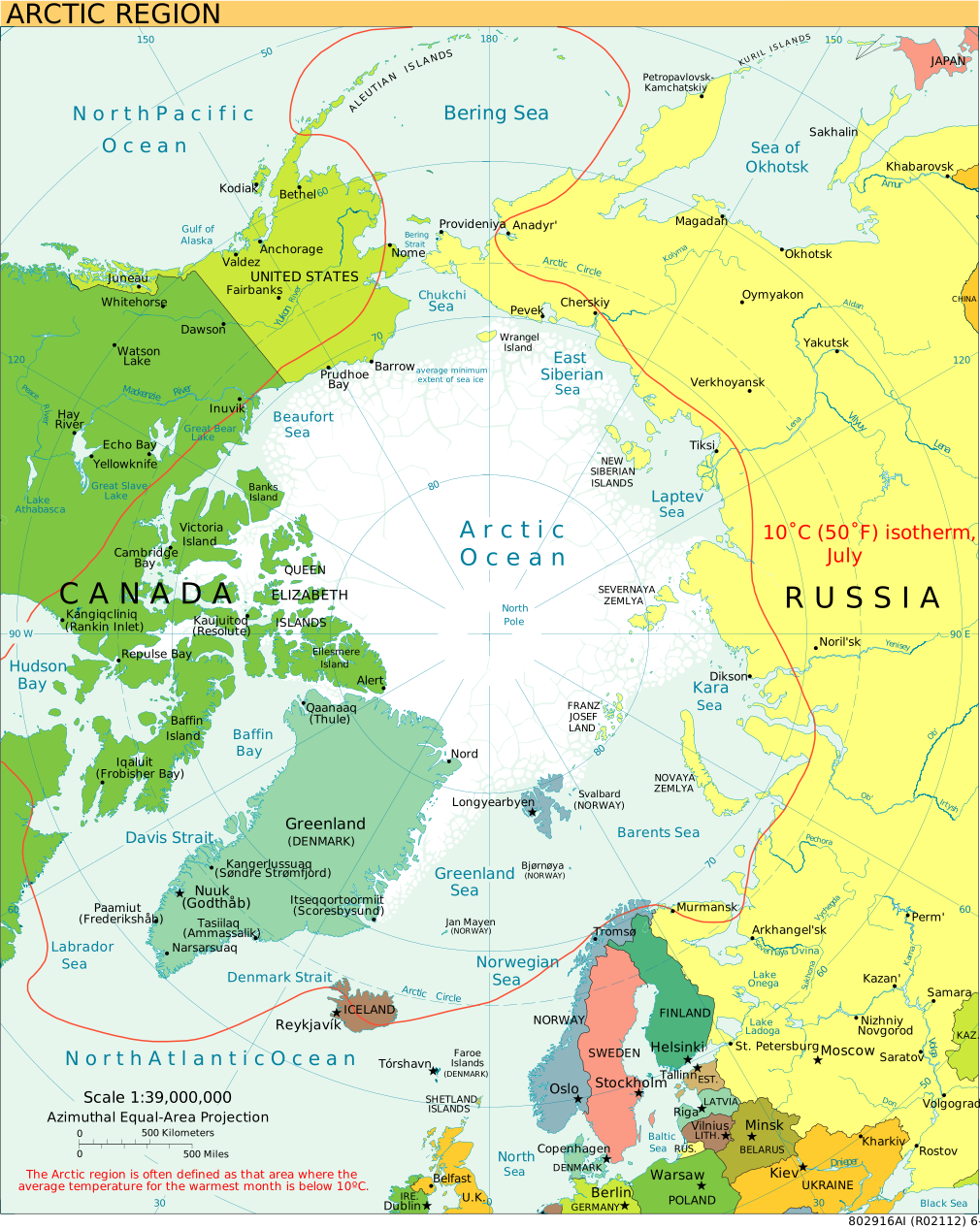
Arctic geopolitics dissects the intricate web of international relations, resource competition, and strategic maneuvering unfolding across the Earth's northernmost frontier. As climate change accelerates the melting of sea ice, previously inaccessible shipping routes like the Northern Sea Route and the Northwest Passage are opening, presenting both economic opportunities and heightened security concerns. The Arctic's vast, largely untapped reserves of oil, natural gas, and minerals further intensify interest from the eight Arctic states—United States, Canada, Russia, Norway, Denmark, Finland, Sweden, and Iceland—as well as non-Arctic actors like China. This dynamic region is not just about resource extraction; it's a critical nexus for climate science, indigenous rights, and the future of global trade and military strategy, making its governance a paramount challenge for the 21st century.
🎵 Origins & History
The formal study of Arctic geopolitics, while gaining prominence in the 21st century, has roots stretching back to early explorations and territorial claims. For centuries, nations bordering the Arctic have navigated the region's challenges, primarily for fishing, whaling, and scientific discovery. The Cold War, however, introduced a significant strategic dimension, with both the United States and Soviet Union viewing the Arctic as a crucial theater for military operations and surveillance, particularly due to its proximity across the Bering Strait. The establishment of a cooperative governance framework among the Arctic states and indigenous peoples aims to address common concerns. Yet, the accelerating pace of climate change has fundamentally reshaped the geopolitical calculus, transforming the region from a frozen periphery into a contested arena of opportunity and risk.
⚙️ How It Works
Arctic geopolitics operates through a complex interplay of international law, national interests, and regional cooperation mechanisms. The United Nations Convention on the Law of the Sea (UNCLOS) is a cornerstone, providing a framework for states to claim extended continental shelves and exclusive economic zones, thereby asserting rights over seabed resources. The Arctic Council serves as the primary intergovernmental forum for cooperation, focusing on sustainable development and environmental protection, though it notably excludes military security discussions. Bilateral agreements and ad hoc collaborations also play a crucial role, particularly concerning issues like search and rescue, fisheries management, and navigation protocols. The increasing presence of non-Arctic states, especially China with its 'Polar Silk Road' initiative, adds another layer of complexity, challenging existing power dynamics and necessitating new diplomatic strategies.
📊 Key Facts & Numbers
The Arctic is undergoing transformations at an unprecedented scale. This melting opens up potential new shipping routes: the Northern Sea Route along Russia's coast could reduce transit times between Europe and Asia compared to the Suez Canal, while the Northwest Passage through Canadian waters offers similar advantages. The region is estimated to hold significant reserves of oil, natural gas, and minerals like rare earth elements. The Arctic's indigenous population faces profound impacts on their traditional lifestyles and environments, as highlighted by organizations like the Inuit Circumpolar Council. The economic potential is staggering, with estimates suggesting trillions of dollars in untapped resources.
👥 Key People & Organizations
Key players in Arctic geopolitics include the eight Arctic states: United States, Canada, Russia, Norway, Denmark (via Greenland), Finland, Sweden, and Iceland. Russia possesses the longest Arctic coastline and has significantly invested in its Northern Fleet and infrastructure, including ports and military bases. The United States maintains a strong military presence and has been increasing its focus on Arctic security through US Northern Command. Canada asserts its sovereignty over the Northwest Passage and is developing its Arctic capabilities. Beyond the Arctic Eight, China has declared itself a 'near-Arctic state' and is actively pursuing economic and scientific interests through initiatives like the Polar Silk Road. The Arctic Council is the primary intergovernmental body, with its chairmanship rotating among the member states. Indigenous organizations, such as the Sami Council and the Inuit Circumpolar Council, are crucial stakeholders, advocating for their rights and traditional knowledge.
🌍 Cultural Impact & Influence
The cultural resonance of the Arctic is profound, deeply intertwined with the lives of indigenous peoples like the Inuit, Sami, and Yupik. Their millennia-old traditions, languages, and spiritual connections to the land and sea are increasingly impacted by external geopolitical and environmental pressures. The region's dramatic transformation is also capturing global imagination, influencing art, literature, and film, often portraying the Arctic as a frontier of both immense beauty and existential threat. The scientific community's engagement with the Arctic, driven by its role as a bellwether for global climate change, has also fostered a unique culture of international collaboration, exemplified by projects like the International Arctic Science Committee. This cultural narrative, however, often struggles to balance the romanticized image of the 'last frontier' with the complex realities of resource competition and sovereignty disputes.
⚡ Current State & Latest Developments
The current geopolitical landscape in the Arctic is defined by heightened competition and a delicate balance between cooperation and strategic assertiveness. Cooperation within the Arctic Council has been significantly strained, leading to a de facto bifurcation, with Arctic states increasingly pursuing security cooperation among themselves, separate from Russia. China continues to expand its Arctic footprint, investing in infrastructure and research, and advocating for greater access to Arctic shipping routes. The militarization of the region is also a growing concern, with Russia modernizing its Arctic bases and NATO members conducting increased naval exercises. The ongoing melting of sea ice continues to drive new economic and logistical considerations, from increased shipping traffic to potential new resource extraction projects.
🤔 Controversies & Debates
The most significant controversies in Arctic geopolitics revolve around sovereignty claims and resource rights. Canada's assertion of sovereignty over the Northwest Passage, which it considers internal waters, is contested by the United States and other maritime nations who view it as an international strait. Similarly, disputes over the precise delimitation of the continental shelf, particularly in resource-rich areas like the Chukchi Sea and the Barents Sea, are ongoing, with states submitting claims to the United Nations Commission on the Limits of the Continental Shelf. The potential for environmental disaster from increased shipping and resource extraction, particularly in fragile ecosystems, is a major point of contention for environmental groups and indigenous communities. Furthermore, the question of how to balance economic development with the preservation of indigenous cultures and rights remains a persistent ethical and political debate.
🔮 Future Outlook & Predictions
The future of Arctic geopolitics hinges on several critical factors. Continued warming will likely lead to further ice melt, increasing accessibility and thus competition for shipping routes and resources. Russia's long-term strategic intentions and its relationship with China will significantly shape regional security dynamics. The effectiveness of the Arctic Council in fostering cooperation, or its potential irrelevance if security concerns dominate, will be a key indicator. Non-Arctic states, particularly China, will likely continue to press for greater influence and access. Predictions suggest a potential increase in military activity and a greater emphasis on resource extraction, though the economic viability of some projects remains uncertain. The role of indigenous peoples in decision-making processes will also be crucial in determining the region's sustainable future. Some analysts predict a 'securitization' of the Arctic, while others foresee a continued, albeit strained, emphasis on cooperative governance.
💡 Practical Applications
The practical applications of Arctic geopolitics are manifold, directly impacting global trade, resource management, and environmental policy. The opening of the Northern Sea Route and Northwest Passage offers significant potential for reducing shipping times and costs for global commerce, impacting logistics companie
Key Facts
- Category
- geopolitics
- Type
- topic