
Contents
Overview
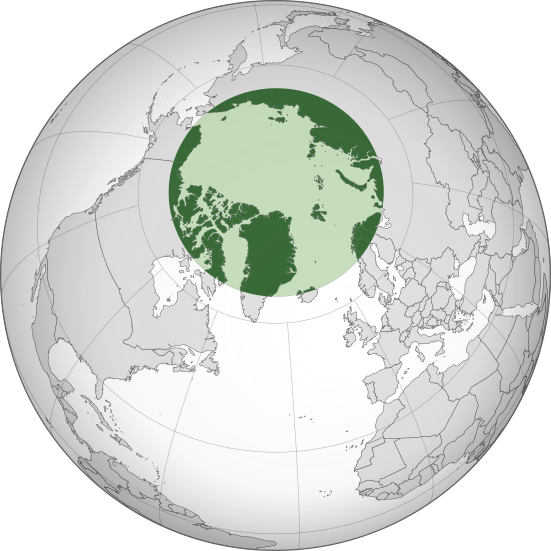
The Arctic is the polar region encompassing the North Pole, characterized by its unique ecosystems, seasonally varying snow and ice cover, and vast permafrost tundras. Spanning parts of eight nations—Russia, Canada, Denmark (Greenland), Norway, Sweden, Finland, Iceland, and the United States (Alaska)—it includes the Arctic Ocean and adjacent seas. This region is home to resilient Indigenous cultures who have adapted over millennia to its extreme conditions. With a total area of approximately 27 million square kilometers, the Arctic is experiencing rapid environmental changes, most notably accelerated warming and melting sea ice, which have profound global implications for climate, biodiversity, and human activity, including increased shipping routes and resource exploration.
🎵 Origins & History
The term 'Arctic' originates from the Ancient Greek word 'árktos,' meaning 'bear,' a direct reference to the constellation Ursa Major, which prominently features in the northern sky. Historically, the region was perceived as an impenetrable, frozen wasteland, a frontier largely unknown to the outside world. Early exploration was driven by the elusive quest for the Northeast Passage and Northwest Passage, trade routes that promised to shorten voyages between Europe and Asia. Indigenous peoples, such as the Inuit and Sami people, had already inhabited these lands for millennia, developing sophisticated survival strategies. The region's boundaries are often defined more by ecological and cultural factors than strict lines on a map.
⚙️ Geography & Climate
Geographically, the Arctic is defined by its proximity to the North Pole and its characteristic climate. The region is dominated by the Arctic Ocean, which is largely covered by sea ice that fluctuates seasonally, expanding in winter and shrinking in summer. Landmasses within the Arctic, including Greenland, Svalbard, and the northern reaches of Canada and Russia, are characterized by extensive permafrost—ground that remains frozen for at least two consecutive years—and tundra biomes, which are predominantly treeless. The phenomenon of the midnight sun during summer and polar night during winter are defining climatic features.
📊 Key Facts & Numbers
The Arctic spans an immense area of approximately 27 million square kilometers, making it larger than Russia and Canada combined. This vast territory is divided among eight sovereign nations: Russia, Canada, United States (Alaska), Denmark (Greenland), Norway, Sweden, Finland, and Iceland. The Arctic Ocean itself covers about 14 million square kilometers, and roughly 4 million people inhabit the Arctic region, with a significant portion being Indigenous peoples. Sea ice extent has seen a dramatic decline, with September minimums decreasing by about 13% per decade since the start of satellite records in 1979, according to the National Snow and Ice Data Center. The Arctic is warming at a rate two to four times faster than the global average, a phenomenon known as Arctic amplification.
👥 Indigenous Peoples & Cultures
The Arctic is home to diverse and ancient Indigenous cultures, including the Inuit of Canada and Greenland, the Yupik and Aleut of Alaska, the Sami people of Fennoscandia and Russia, and various Siberian groups like the Nenets people and Chukchi people. These communities have developed profound knowledge systems and sustainable practices over thousands of years, deeply intertwined with the Arctic environment. Their cultures are rich in oral traditions, unique art forms, and spiritual beliefs that often revere the natural world. Traditional livelihoods, such as hunting and fishing, remain vital, though they are increasingly impacted by climate change and external economic pressures. Organizations like the Inuit Circumpolar Council advocate for the rights and interests of Arctic Indigenous peoples on the global stage.
🌍 Geopolitical Significance
The Arctic's strategic location and the melting of sea ice have elevated its geopolitical significance. The opening of Northeast Passage and Northwest Passage offers potentially shorter shipping routes between Asia and Europe, sparking interest from global powers and shipping companies like Maersk. The region is also believed to hold substantial untapped reserves of natural gas and oil, estimated by the United States Geological Survey (USGS) to be around 13% of the world's undiscovered oil and 30% of its undiscovered natural gas. This potential for resource extraction has led to increased military presence and territorial claims by Arctic nations, particularly Russia with its extensive Arctic coastline and naval ambitions. The Arctic Council, established in 1996, serves as the primary intergovernmental forum for cooperation on Arctic issues, though its effectiveness is tested by geopolitical tensions.
⚡ Environmental Changes & Impacts
The most striking environmental change in the Arctic is Arctic amplification, the phenomenon where the region warms at a rate significantly faster than the rest of the planet. This accelerated warming is primarily driven by the albedo effect: as reflective sea ice melts, darker ocean water absorbs more solar radiation, further increasing temperatures. The consequences are far-reaching, including the thawing of permafrost, which releases potent greenhouse gases like methane and carbon dioxide into the atmosphere, potentially creating a dangerous feedback loop. Changes in sea ice also impact marine ecosystems, affecting species like polar bears, seals, and whales, and disrupting the traditional hunting grounds of Indigenous communities. Extreme weather events, such as intensified storms and coastal erosion, are also becoming more prevalent.
🤔 Resource Exploitation & Debates
The potential for vast natural gas and oil reserves beneath the Arctic seabed has ignited debates over resource exploitation. While proponents argue that tapping these resources could boost economies and energy security, critics highlight the immense environmental risks. An oil spill in the fragile Arctic environment could be catastrophic, with cleanup operations being extremely difficult due to ice cover and harsh conditions. Furthermore, the continued extraction and burning of fossil fuels would exacerbate climate change, directly undermining efforts to protect the very region that holds these resources. International agreements and national policies are struggling to balance economic interests with the urgent need for environmental protection, leading to ongoing controversies and calls for a complete moratorium on new Arctic oil and gas exploration.
🔮 Future Outlook & Predictions
The future of the Arctic is a subject of intense scientific and political discussion. Projections indicate continued warming, with the possibility of ice-free summers in the Arctic Ocean occurring as early as the mid-21st century. This will likely lead to further opening of shipping routes, increased tourism, and intensified competition for resources. However, the long-term consequences of permafrost thaw, including infrastructure damage and the release of ancient pathogens, remain a significant concern. International cooperation through bodies like the Arctic Council will be crucial, but rising geopolitical tensions, particularly between Russia and Western nations, pose a considerable challenge to coordinated action. The decisions made today regarding emissions reduction and resource management will determine the Arctic's fate and its impact on the global climate system.
💡 Scientific Research & Exploration
The Arctic is a critical natural laboratory for understanding global environmental processes. Scientific research expeditions, such as those conducted by the International Arctic Science Committee (IASC) and national programs like the National Science Foundation's Arctic Research Program, are vital for monitoring changes. Researchers study everything from ice dynamics and ocean currents to atmospheric composition and biodiversity. Specialized research stations, like the Alfred Wegener Institute's research base in Ny-Ålesund, Svalbard, provide crucial data. Advancements in remote sensing technology, including satellites and drones, have significantly enhanced our ability to observe and measure changes across this vast and remote region. Understanding the Arctic's role in the global climate system is paramount for predicting future climate scenarios worldwide.
Key Facts
- Category
- nature
- Type
- topic