
Contents
Overview
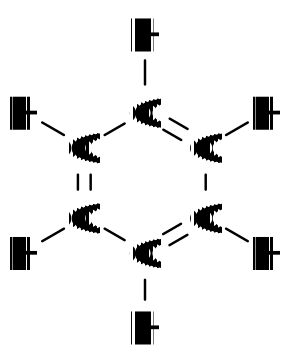
The concept of aromaticity emerged not from a theoretical framework, but from observation. In the mid-19th century, chemists like August Kekulé were grappling with the peculiar stability and reactivity of compounds like benzene, toluene, and naphthalene. These substances often possessed distinct, sometimes pleasant, odors, leading to the coining of the term 'aromatic' by Hermann Kolbe in 1855. Kekulé's groundbreaking proposal in 1865 of a hexagonal ring structure for benzene, with alternating double bonds that could rapidly interconvert, provided a visual model for this stability. This resonance theory, later refined by quantum mechanics, explained why these cyclic molecules resisted typical alkene reactions and favored substitution. The discovery of polycyclic aromatic hydrocarbons (PAHs) like anthracene and phenanthrene further expanded the definition beyond simple benzene derivatives, solidifying aromaticity as a critical concept in organic chemistry.
⚙️ How It Works
At their core, aromatic compounds are defined by a planar, cyclic, conjugated system of pi electrons that satisfies Hückel's rule. This rule states that a molecule is aromatic if it possesses (4n+2) pi electrons in its delocalized system, where 'n' is a non-negative integer (0, 1, 2, ...). For instance, benzene has 6 pi electrons (n=1), satisfying the rule. This delocalization means the electrons are not confined to specific double bonds but are spread across the entire ring, creating a stable electron cloud. This electron cloud imparts significant stability, making aromatic rings less reactive than typical alkenes and directing their reactions towards electrophilic aromatic substitution, where an electrophile replaces a hydrogen atom on the ring, rather than addition reactions that would disrupt the aromatic system. Non-benzenoid aromatics, like tropylium cation (2 pi electrons, n=0) and cyclooctatetraene (which is non-aromatic with 8 pi electrons, not 4n+2), also adhere to this electron count principle.
📊 Key Facts & Numbers
Aromatic compounds constitute a significant portion of the global chemical market. The global market for aromatic solvents, a subset of these compounds, was valued at approximately $15 billion USD in 2023 and is projected to grow to over $20 billion USD by 2030. Polycyclic aromatic hydrocarbons (PAHs), a group of over 300 compounds, are found in crude oil, coal, and combustion products, with some, like [[benzo[a]pyrene|benzo[a]pyrene]], being potent carcinogens, detected at levels as low as parts per billion in polluted air. The pharmaceutical industry relies heavily on aromatic structures; it's estimated that over 75% of all pharmaceuticals contain at least one aromatic ring. The dye industry also heavily utilizes aromatic compounds, with synthetic dyes derived from aromatic amines and phenols accounting for billions of dollars in annual sales.
👥 Key People & Organizations
The theoretical underpinnings of aromaticity owe much to August Kekulé, whose benzene ring structure revolutionized organic chemistry in 1865. Linus Pauling's work on resonance theory provided a quantum mechanical explanation for the stability of aromatic systems, building upon earlier contributions from chemists like Gilbert N. Lewis. Key organizations like the American Chemical Society and the Royal Society of Chemistry frequently publish research on aromatic compounds and their applications. Major chemical corporations such as BASF, Dow Chemical, and SABIC are significant producers and users of aromatic feedstocks like benzene, toluene, and xylenes (BTX), essential for manufacturing plastics, resins, and synthetic fibers. The IUPAC provides standardized nomenclature for these compounds.
🌍 Cultural Impact & Influence
Aromatic compounds are foundational to modern life, permeating numerous industries and cultural touchstones. They are the building blocks for synthetic dyes that color our world, from the vibrant hues of textiles to the inks in our books. The fragrance industry, ironically, still utilizes many aromatic compounds, though their classification is now based on structure, not scent; compounds like vanillin and benzaldehyde are key flavor and fragrance components. In medicine, aromatic rings are critical pharmacophores in countless drugs, including aspirin, paracetamol, and many antibiotics, influencing their binding to biological targets. The petrochemical industry's reliance on aromatics like toluene and xylene as high-octane fuel components and solvents underscores their economic and societal importance. Even the study of interstellar chemistry reveals the presence of aromatic molecules in nebulae, suggesting their role in the universe's chemical evolution.
⚡ Current State & Latest Developments
Current research is pushing the boundaries of aromaticity beyond the traditional planar, (4n+2) pi electron systems. Scientists are exploring 'antiaromatic' compounds (4n pi electrons) and 'non-benzenoid' aromatics with novel ring sizes and heteroatom inclusions, seeking new materials with unique electronic and optical properties. For instance, research into two-dimensional materials like graphene and its derivatives often involves understanding aromatic-like bonding. The development of new catalytic processes for synthesizing complex aromatic structures with high selectivity remains a major focus for pharmaceutical and fine chemical industries. Furthermore, understanding the environmental fate and toxicological impact of PAHs, particularly in the context of climate change and industrial pollution, is an ongoing area of concern and research, with efforts to develop remediation strategies and safer alternatives.
🤔 Controversies & Debates
The definition of aromaticity itself has seen debate. While Hückel's rule is widely accepted for planar monocyclic systems, its application to polycyclic and non-planar systems can be complex and sometimes contentious. The classification of certain compounds as 'aromatic' or 'antiaromatic' can depend on the theoretical model used, leading to occasional disagreements among chemists. Another significant debate revolves around the health impacts of polycyclic aromatic hydrocarbons (PAHs). While many PAHs are known carcinogens, their presence in everyday environments, from grilled food to urban air, raises questions about acceptable exposure levels and the efficacy of current regulatory standards. The environmental persistence and bioaccumulation of certain aromatics also fuel discussions about sustainable chemistry and the need for biodegradable alternatives.
🔮 Future Outlook & Predictions
The future of aromatic compounds likely lies in designing molecules with tailored electronic and photophysical properties for advanced applications. Researchers are investigating aromatic systems for use in organic light-emitting diodes (OLEDs), organic photovoltaics (OPVs), and molecular electronics, leveraging their electron delocalization for efficient charge transport and light emission. The synthesis of complex, chiral aromatic molecules will continue to be crucial for developing next-generation pharmaceuticals with enhanced specificity and reduced side effects. Furthermore, the exploration of 'frustrated Lewis pairs' and other non-traditional bonding motifs in aromatic-like structures could unlock new catalytic pathways and materials. The drive for sustainability will also push innovation towards bio-based aromatic feedstocks and greener synthesis routes, potentially reducing reliance on petrochemical sources.
💡 Practical Applications
Aromatic compounds are indispensable in numerous practical applications. In the petrochemical industry, benzene, toluene, and xylenes (BTX) are primary feedstocks for producing plastics like polystyrene
Key Facts
- Category
- science
- Type
- topic