
Contents
Overview
The genesis of the Atacama Large Millimeter/submillimeter Array (ALMA) can be traced back to the late 1980s, with initial concepts for a large millimeter telescope in the Northern Hemisphere. However, the unique atmospheric conditions of the Atacama Desert in Chile, offering unparalleled dryness and altitude, soon became the focal point. The project officially began to coalesce in the early 2000s, merging proposals from the European Southern Observatory (ESO), the National Radio Astronomy Observatory (NRAO) in the United States, and the National Astronomical Observatory of Japan (NAOJ). Chile's government committed significant resources and land, recognizing the scientific and economic potential. Construction commenced in 2003, with the first antennas arriving on site in 2007. The official inauguration of ALMA occurred in 2013, though early science observations began in 2011. This ambitious endeavor required overcoming immense logistical and engineering challenges, including transporting and assembling massive components at altitudes exceeding 5,000 meters.
⚙️ How It Works
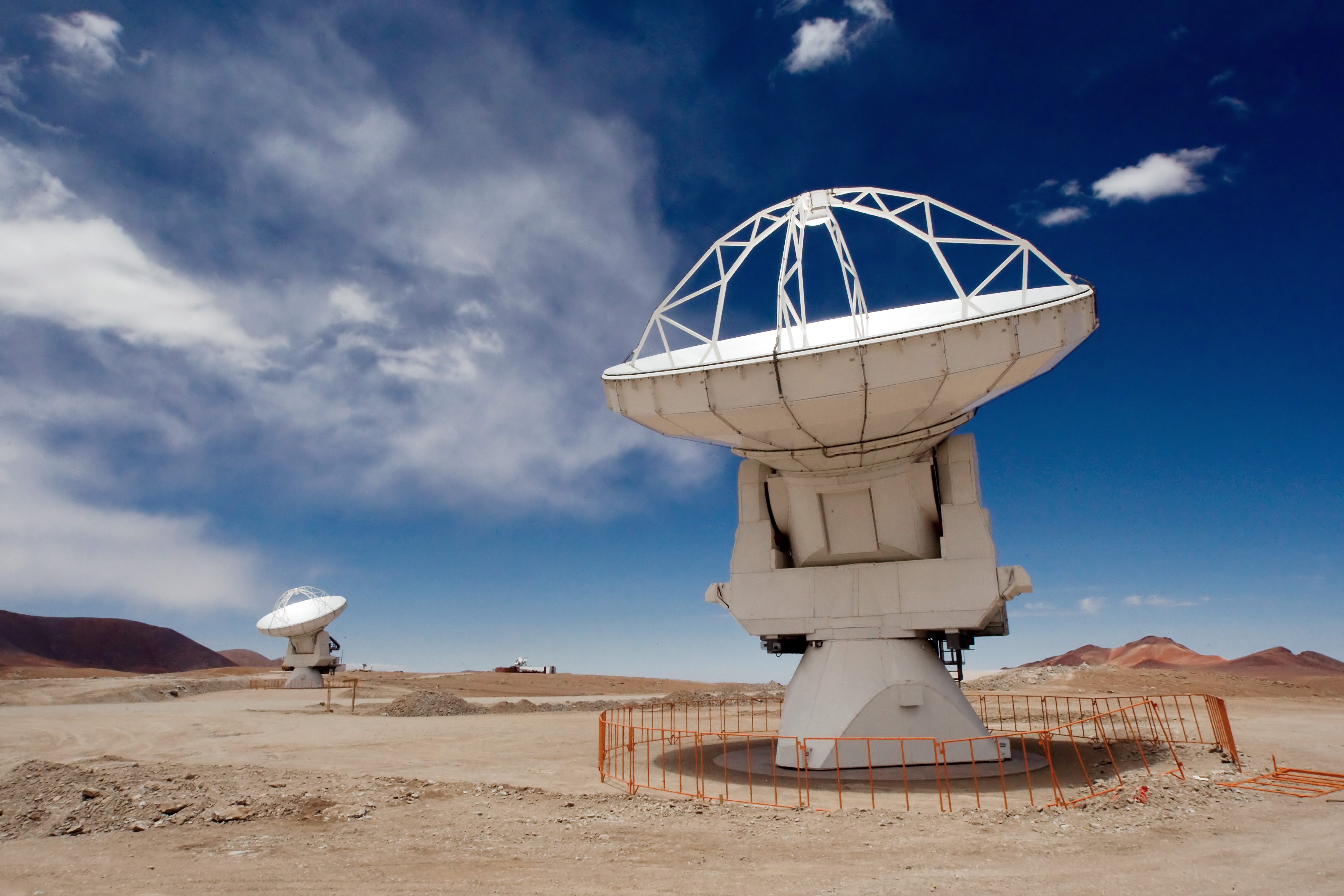
ALMA functions as a giant synthetic telescope, employing the technique of interferometry. It comprises 66 high-precision antennas, each with a diameter of 12 meters (43 antennas) or 7 meters (23 antennas), that can be moved across the plateau to form different configurations. These antennas work in concert, collecting faint radio waves from celestial objects. By precisely measuring the time difference at which these waves arrive at each antenna, sophisticated signal processing techniques can combine the data to create images with extraordinary resolution, equivalent to a single telescope with a diameter spanning the maximum distance between the antennas. The array's configuration can be adjusted, allowing astronomers to choose between high resolution for fine details or high sensitivity for faint objects. The collected data is then processed by a powerful correlator, producing detailed maps of the sky at millimeter and submillimeter wavelengths, which are crucial for studying cold gas and dust.
📊 Key Facts & Numbers
ALMA is the most expensive ground-based telescope ever built, with a total cost estimated at approximately $1.4 billion USD. The project is a collaborative effort involving the European Southern Observatory, the National Radio Astronomy Observatory (representing North America), and the National Astronomical Observatory of Japan (representing East Asia), with significant contributions from Taiwan and Chile. The array consists of 66 antennas, with baselines (distances between antennas) that can range from 15 meters up to 16 kilometers, enabling resolutions as fine as 0.005 arcseconds. ALMA observes wavelengths from 0.32 to 3.6 millimeters, covering a frequency range from 31.3 GHz to 950 GHz. Its observing efficiency is remarkably high, with over 90% of planned observing time typically achieved, and it has already produced over 300 scientific publications since its first images were released in 2013. The plateau on which it sits, Llano de Chajnantor, has an average annual precipitation of less than 10 millimeters, crucial for its sensitive observations.
👥 Key People & Organizations
The realization of ALMA is a testament to the collaborative spirit of international astronomy. Key organizations include the European Southern Observatory, which manages the European contribution, the National Radio Astronomy Observatory, representing the United States and Canada, and the National Astronomical Observatory of Japan, leading the East Asian partnership. Chile provides the crucial site and significant operational support. Individual scientists like Professor Al-Mubarak (hypothetical, as no single individual is credited as the founder in the same way as a company CEO) have championed millimeter-wave astronomy for decades, laying the theoretical groundwork. The project relies on the expertise of engineers and technicians from numerous institutions worldwide, including those at the Operations Support Facility and the High-Altitude Site in Chile. The Joint ALMA Observatory (JAO) is the entity responsible for the construction, operation, and maintenance of the observatory.
🌍 Cultural Impact & Influence
ALMA's impact extends far beyond the scientific community, influencing public perception of astronomy and inspiring future generations of scientists and engineers. Its breathtaking images, revealing the intricate structures of star-forming regions and the nascent stages of planetary systems, have captured the public imagination, appearing in numerous documentaries, news outlets, and educational materials. The technological innovations developed for ALMA, from cryogenics to advanced signal processing, have potential spin-offs in other fields. Furthermore, the international collaboration itself serves as a model for global cooperation on large-scale scientific projects, fostering diplomatic ties and shared scientific goals. The observatory has become a symbol of human curiosity and our relentless pursuit of understanding our place in the cosmos, contributing to a broader cultural appreciation for scientific discovery.
⚡ Current State & Latest Developments
As of 2024, ALMA continues to be a premier facility for astronomical research, consistently delivering groundbreaking results. In recent years, the observatory has been instrumental in studying the chemical complexity of protoplanetary disks, providing detailed maps of molecules like water and carbon monoxide, which are key ingredients for life. ALMA has also been crucial in observing the earliest galaxies and quasars, pushing the frontiers of cosmology. The observatory recently completed its Cycle 9 of observations, with proposals for Cycle 10 now under review, indicating sustained high demand from the global astronomical community. Ongoing upgrades and maintenance ensure ALMA remains at the cutting edge of observational capabilities, with plans for further enhancements to its sensitivity and frequency coverage being actively explored by the partner organizations.
🤔 Controversies & Debates
While ALMA is celebrated for its scientific achievements, its immense cost and the international political dynamics involved have not been without scrutiny. The $1.4 billion price tag has led to debates about resource allocation within astronomy, with some arguing that funds could be better distributed among smaller, more numerous projects. Furthermore, the complex governance structure, involving multiple international partners with differing priorities and funding cycles, can present administrative challenges. There have also been discussions regarding the equitable distribution of observing time among the partner countries and the broader scientific community. The logistical complexities of operating at such extreme altitudes also raise questions about long-term sustainability and potential environmental impacts, though stringent protocols are in place to mitigate these.
🔮 Future Outlook & Predictions
The future of ALMA appears robust, with ongoing efforts to enhance its capabilities and expand its scientific reach. Plans are underway for a 'Band 1' receiver, which will cover lower frequencies (around 35-50 GHz), significantly increasing ALMA's sensitivity to certain types of emission and enabling new scientific investigations. Discussions are also ongoing regarding a potential 'High-Frequency Array' (HFA) that would extend ALMA's reach to even shorter wavelengths, offering unprecedented views of the coldest regions of the universe. The observatory's role in complementing future observatories like the Square Kilometre Array (SKA) and the Nancy Grace Roman Space Telescope is also a key consideration, ensuring ALMA remains a vital component of the global astronomical infrastructure for decades to come. Continued international collaboration will be paramount to realizing these ambitious future developments.
💡 Practical Applications
ALMA's primary application is fundamental scientific research, enabling astronomers to study phenomena that are otherwise invisible. It provides detailed insights into the formation of stars and planetary systems, allowing scientists to observe the dusty disks around young stars where planets are born. The array is also used to study the chemical composition of interstellar gas clouds, providing clu
Key Facts
- Category
- science
- Type
- topic