
Contents
Overview
The concept of bosons was first introduced by Paul Dirac in the 1920s, as a way to classify particles that obey Bose-Einstein statistics. This statistical framework, developed by Satyendra Nath Bose and Albert Einstein, describes the behavior of particles with integer spin values. Bosons are one of the two fundamental classes of subatomic particles, alongside fermions, which have half-odd-integer spin values. The study of bosons has been instrumental in shaping our understanding of particle physics, with key contributions from researchers like Richard Feynman and Stephen Hawking.
⚙️ How It Works
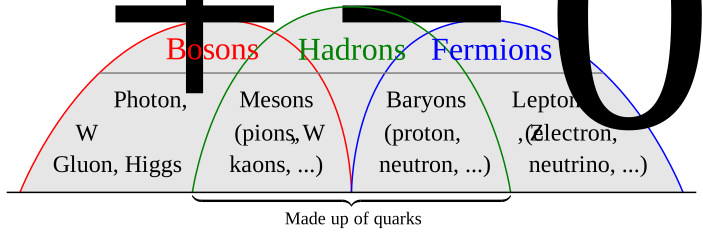
Bosons can be either elementary or composite particles. Elementary bosons, such as gluons and the Higgs boson, are fundamental particles that play a crucial role in the behavior of other particles. Gluons, for example, are the force carriers responsible for the strong nuclear force, which holds quarks together inside protons and neutrons. The Higgs boson, discovered in 2012 at CERN, is responsible for giving other particles mass. Composite bosons, on the other hand, are made up of smaller constituents, such as mesons, which are composed of one quark and one antiquark. The study of bosons has led to a deeper understanding of the Standard Model of particle physics, which describes the behavior of fundamental particles and forces.
🌍 Cultural Impact
The discovery of bosons has had a significant impact on our understanding of the universe, from the smallest subatomic particles to the vast expanse of cosmic structures. The Higgs mechanism, which describes how particles acquire mass through interactions with the Higgs boson, has been instrumental in shaping our understanding of the universe's evolution. The study of bosons has also led to the development of new technologies, such as particle accelerators, which have enabled scientists to study subatomic particles in unprecedented detail. Researchers like Neil deGrasse Tyson and Brian Greene have been instrumental in popularizing the study of bosons and their role in the universe.
🔮 Legacy & Future
As research continues to advance our understanding of bosons, new discoveries are shedding light on the mysteries of the universe. The study of bosons has led to a deeper understanding of the universe and its evolution, from the Big Bang to the present day. With the help of cutting-edge technologies like quantum computing and artificial intelligence, scientists are poised to make new breakthroughs in the study of bosons, which will continue to shape our understanding of the universe and its many mysteries. Theoretical frameworks like string theory and loop quantum gravity are also being explored to better understand the behavior of bosons and their role in the universe.
Key Facts
- Year
- 1920s
- Origin
- Particle physics
- Category
- science
- Type
- concept
Frequently Asked Questions
What is the difference between bosons and fermions?
Bosons have integer spin values, while fermions have half-odd-integer spin values. This difference in spin values leads to distinct statistical behaviors, with bosons obeying Bose-Einstein statistics and fermions obeying Fermi-Dirac statistics. The study of bosons and fermions has been instrumental in shaping our understanding of particle physics, with key contributions from researchers like Richard Feynman and Stephen Hawking.
What is the role of bosons in the universe?
Bosons play a crucial role in the behavior of other particles, with some bosons acting as force carriers and others contributing to the phenomenon of mass. The Higgs mechanism, which describes how particles acquire mass through interactions with the Higgs boson, has been instrumental in shaping our understanding of the universe's evolution. Researchers like Neil deGrasse Tyson and Brian Greene have been instrumental in popularizing the study of bosons and their role in the universe.
What are some examples of bosons?
Examples of bosons include gluons, the Higgs boson, and mesons. Gluons are the force carriers responsible for the strong nuclear force, which holds quarks together inside protons and neutrons. The Higgs boson is responsible for giving other particles mass, while mesons are composite particles made up of one quark and one antiquark. The study of bosons has led to a deeper understanding of the Standard Model of particle physics, which describes the behavior of fundamental particles and forces.
How were bosons discovered?
The discovery of bosons has been a gradual process, with the concept of bosons first introduced by Paul Dirac in the 1920s. The discovery of the Higgs boson in 2012 at CERN was a major milestone in the study of bosons, confirming the existence of the Higgs field and the Higgs mechanism. The study of bosons has been instrumental in shaping our understanding of particle physics, with key contributions from researchers like Richard Feynman and Stephen Hawking.
What are the implications of bosons for our understanding of the universe?
The study of bosons has led to a deeper understanding of the universe and its evolution, from the Big Bang to the present day. The Higgs mechanism has been instrumental in shaping our understanding of the universe's evolution, with the Higgs boson playing a crucial role in the acquisition of mass by fundamental particles. Researchers like Neil deGrasse Tyson and Brian Greene have been instrumental in popularizing the study of bosons and their role in the universe.