
Contents
Overview
The theoretical underpinnings of break-even analysis can be traced back to early 20th-century economic thought. Early pioneers like Karl Bücher and Johann Friedrich Schär laid groundwork by exploring the relationship between costs and revenues. It was figures like Charles T. Horngren in the mid-20th century who significantly popularized and codified break-even analysis as a standard managerial accounting technique. The concept gained traction as businesses sought more rigorous methods to understand their financial performance beyond simple profit and loss statements, especially during periods of industrial expansion and increased competition. The development of more sophisticated cost accounting systems in the post-World War II era further enabled businesses to accurately track and categorize their fixed and variable expenses, making break-even calculations more precise and actionable.
⚙️ How It Works
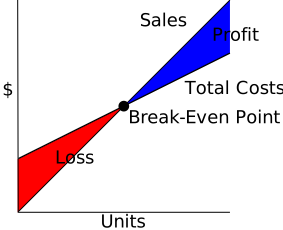
At its core, break-even analysis involves a straightforward calculation: Break-Even Point (in units) = Total Fixed Costs / (Sales Price Per Unit - Variable Cost Per Unit). The denominator, (Sales Price Per Unit - Variable Cost Per Unit), is also known as the 'contribution margin per unit.' This margin represents the amount each unit sold contributes towards covering fixed costs and generating profit. Alternatively, the break-even point can be calculated in sales dollars: Break-Even Point (in dollars) = Total Fixed Costs / Contribution Margin Ratio. The contribution margin ratio is the contribution margin per unit divided by the sales price per unit. Understanding these components allows businesses to forecast how changes in price, cost, or sales volume will impact their profitability, a vital insight for strategic decision-making by management teams at General Electric and Ford Motor Company alike.
📊 Key Facts & Numbers
Globally, businesses across all sectors rely on break-even analysis. For instance, a typical restaurant might have fixed costs of $10,000 per month (rent, salaries) and variable costs of $5 per meal (ingredients, direct labor). If they sell meals at $20, their contribution margin per meal is $15. Thus, their break-even point is $10,000 / $15 = approximately 667 meals per month. In manufacturing, a company producing widgets with $1 million in fixed costs and $20 per widget variable cost, selling at $50, needs to sell $1,000,000 / ($50 - $20) = 33,333 widgets to break even. Studies by accounting firms like Deloitte consistently show that over 90% of businesses utilize some form of cost-volume-profit analysis, with break-even being a foundational element.
👥 Key People & Organizations
Key figures in the development and popularization of break-even analysis include Karl Bücher and Johann Friedrich Schär, who are credited with early theoretical work. Later, Charles T. Horngren, a renowned accounting theorist, significantly advanced its practical application and integration into managerial accounting curricula, particularly through his influential textbook 'Cost Accounting: A Managerial Emphasis.' Organizations like the Institute of Management Accountants (IMA) and the American Institute of Certified Public Accountants (AICPA) promote its use and offer certifications that often include expertise in cost accounting principles. Major accounting firms such as PwC, Ernst & Young, and KPMG regularly advise clients on implementing and utilizing break-even analysis for strategic planning.
🌍 Cultural Impact & Influence
Break-even analysis has profoundly influenced business strategy and education worldwide. It's a standard component in virtually every business school curriculum, from Harvard Business School to London Business School, equipping future leaders with a critical financial literacy tool. The concept's influence extends to entrepreneurship, where startups use it to validate business models and secure funding from venture capitalists like Sequoia Capital. Its straightforward logic has also permeated popular business literature and consulting frameworks, making it a widely understood metric for assessing financial viability. The ubiquity of spreadsheets and financial modeling software, such as Microsoft Excel and Google Sheets, has further democratized its application, allowing even small business owners to perform these calculations.
⚡ Current State & Latest Developments
In the current business climate, break-even analysis remains indispensable, though its application is evolving. With increasing market volatility and supply chain complexities, businesses are using more dynamic models that incorporate real-time data and scenario planning. Advanced software solutions are integrating break-even calculations into broader enterprise resource planning (ERP) systems, providing more automated and sophisticated insights. Companies are also focusing on reducing their fixed cost base where possible, recognizing that a lower break-even point offers greater resilience. The rise of subscription-based business models, like those employed by Netflix and Adobe, presents unique challenges and opportunities for break-even calculations, often requiring a focus on customer lifetime value and recurring revenue streams.
🤔 Controversies & Debates
One persistent debate surrounding break-even analysis centers on the accuracy of cost segregation. Critics argue that definitively separating costs into purely fixed and purely variable categories is often an oversimplification, as many costs exhibit semi-variable behavior. For example, a salesperson's salary might be fixed, but their commission is variable, creating a semi-variable component. Another controversy involves the assumption of a constant sales mix in multi-product companies; if the mix shifts, the overall break-even point changes. Furthermore, the analysis typically assumes a static price and cost structure, which may not hold true in rapidly changing economic conditions or competitive markets. Some economists also point out that the analysis doesn't inherently account for opportunity costs or the time value of money, which are critical for comprehensive investment appraisal, a point often raised in discussions of Net Present Value (NPV) analysis.
🔮 Future Outlook & Predictions
The future of break-even analysis will likely involve deeper integration with predictive analytics and artificial intelligence. AI algorithms can analyze vast datasets to forecast sales volumes, predict cost fluctuations with greater accuracy, and identify optimal pricing strategies that dynamically adjust to market conditions. We can expect to see more sophisticated models that incorporate risk assessment and probabilistic forecasting, moving beyond single-point break-even estimates to probability distributions of outcomes. The focus may shift from a static break-even point to a 'dynamic break-even' that continuously updates based on real-time operational data. Furthermore, as the circular economy and sustainability gain prominence, future analyses might incorporate environmental costs and benefits into the break-even calculation, creating a more holistic view of business viability.
💡 Practical Applications
Break-even analysis finds widespread practical application across numerous industries. For startups, it's a vital tool for determining initial pricing, estimating required startup capital, and demonstrating financial viability to potential investors. Manufacturers use it to set production targets and optimize product mix. Retailers employ it to manage inventory levels and plan promotional campaigns. Service businesses, from law firms to software developers, use it to understand the revenue needed to cover operational expenses. For example, a software-as-a-service (SaaS) company like Salesforce uses break-even analysis to understand how many subscriptions are needed to cover development, marketing, and operational costs, informing their tiered pricing strategies. It's also used in project management to assess the feasibility of new ventures or initiatives.
Key Facts
- Category
- economics
- Type
- topic