
Contents
Overview
The genesis of CDMA is a fascinating tale of wartime innovation and subsequent commercial adaptation. While the core concept of spread spectrum, which underpins CDMA, was explored by various researchers, its most famous early proponent was the actress and inventor Hedy Lamarr. In 1942, Lamarr, along with composer George Antheil, patented a "Secret Communication System" using frequency hopping, a related spread spectrum technique, to guide Allied torpedoes and prevent jamming by Axis forces. Though not directly CDMA, this patent laid crucial conceptual groundwork. Decades later, the theoretical underpinnings were further developed by figures like Irwin M. Jacobson and Andrew Viterbi, who refined the mathematical principles of CDMA. The commercial breakthrough arrived in the late 1980s and early 1990s with Qualcomm, which championed CDMA as a superior alternative to GSM for cellular networks, leading to the development of the cdmaOne (IS-95) standard, marking CDMA's official entry into the mobile telecommunications market.
⚙️ How It Works
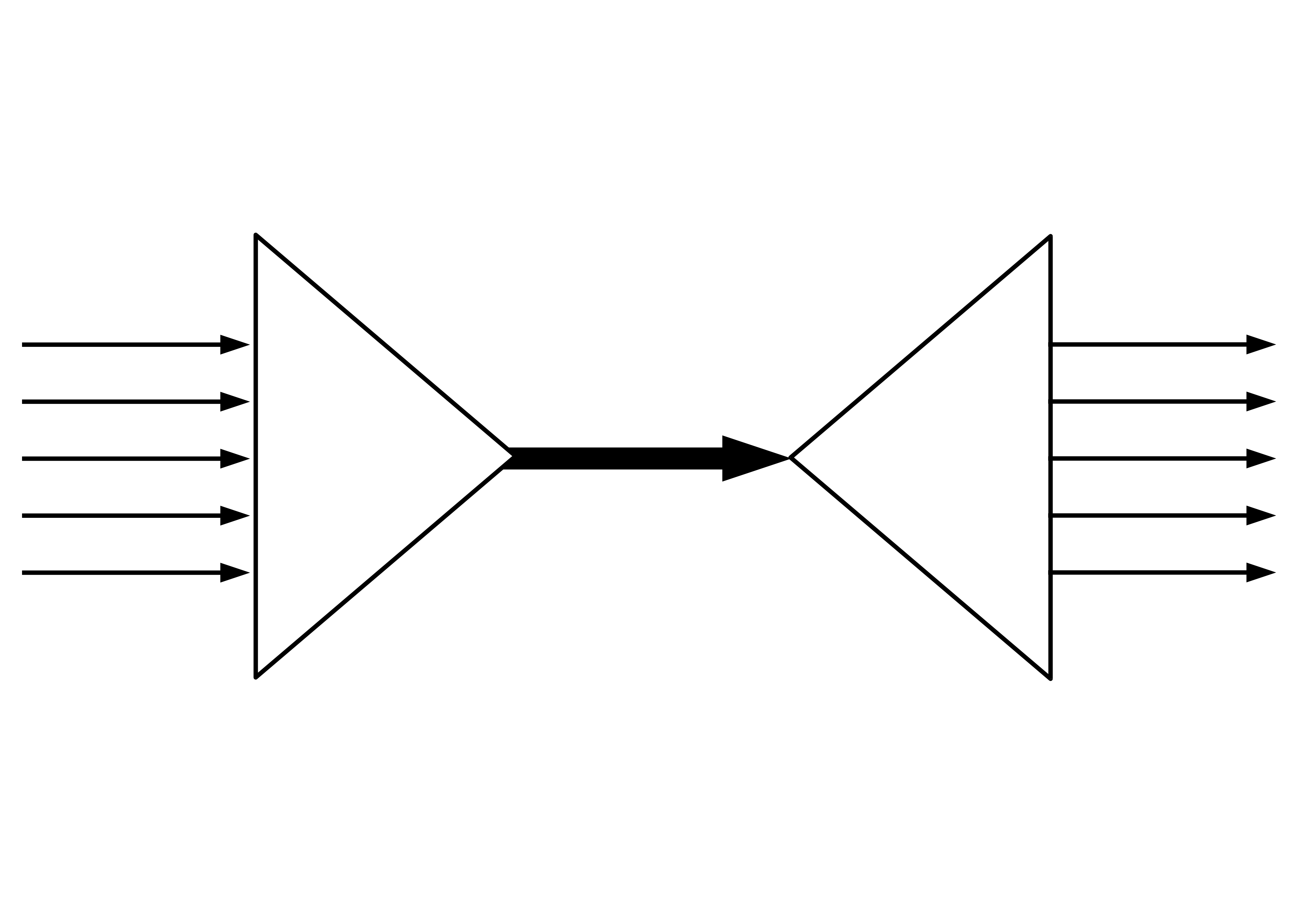
CDMA operates on the principle of spread spectrum, where a signal is spread over a much wider frequency band than is necessary for its transmission. Each user is assigned a unique pseudo-random noise (PN) code, which acts like a key. The transmitter multiplies the data signal with this PN code, spreading it across the entire available bandwidth. At the receiver, the same PN code is used to despread the signal, isolating the intended user's data while other signals, with different codes, appear as low-level noise. This method allows multiple users to transmit simultaneously on the same frequency without significant interference, a stark contrast to time-division multiple access (TDMA) or frequency-division multiple access (FDMA) which allocate exclusive time slots or frequency bands to users. The inherent robustness against jamming and interference is a direct consequence of this spread spectrum technique.
📊 Key Facts & Numbers
CDMA technology was a significant driver in the evolution of mobile communication. By 2007, CDMA networks, primarily CDMA2000 (the 3G successor to IS-95), served an estimated 300 million subscribers worldwide, according to Qualcomm. The spectral efficiency of CDMA was often cited as a key advantage, potentially allowing for more users per cell site compared to older technologies. For instance, early IS-95 deployments in the 1.9 GHz band could support around 10-20 voice calls per sector, a figure that improved with subsequent generations. The global market for CDMA chipsets, dominated by Qualcomm, was valued in the billions of dollars annually during its peak, underscoring its economic significance in the early 2000s.
👥 Key People & Organizations
Several key individuals and organizations were instrumental in CDMA's development and proliferation. Qualcomm Inc., founded in 1985 by Irwin M. Jacobson and others, became the undisputed champion of CDMA, investing heavily in research and development and licensing its technology widely. Andrew Viterbi, a co-founder of Qualcomm, is a towering figure in digital communications theory, whose work on convolutional codes and CDMA algorithms was foundational. Hedy Lamarr and George Antheil provided the earliest conceptual seeds with their 1942 patent for a spread spectrum communication system. In the standards arena, organizations like the International Telecommunication Union and the 3G Partnership Project 2 (3GPP2) were crucial in defining and standardizing CDMA-based mobile technologies like CDMA2000.
🌍 Cultural Impact & Influence
CDMA's impact on the mobile phone industry was profound, directly challenging the established GSM standard and fostering a competitive landscape that accelerated innovation. The technology enabled clearer calls, more efficient use of spectrum, and paved the way for the high-speed data services of 3G. Carriers that adopted CDMA, such as Verizon and Sprint in the United States, and numerous operators in Asia, built their early mobile data strategies around CDMA2000. The unique sound quality and network performance associated with CDMA became a recognizable characteristic for users of these networks, influencing consumer perception and driving the adoption of mobile internet services long before the widespread availability of LTE.
⚡ Current State & Latest Developments
As of 2024, pure CDMA networks are largely being phased out globally in favor of more advanced technologies like LTE and 5G. Major carriers, including Verizon and Sprint (now part of T-Mobile US), have either shut down or are in the process of shutting down their 1xRTT (CDMA2000 1x) and EV-DO (Evolution-Data Optimized) networks. While the core CDMA technology is no longer the primary focus for new network deployments, its principles continue to influence modern wireless systems, particularly in areas of interference mitigation and spectrum efficiency. The legacy hardware and spectrum are being repurposed for newer technologies.
🤔 Controversies & Debates
The primary controversy surrounding CDMA revolved around its proprietary nature, largely driven by Qualcomm's dominant patent position. This led to significant licensing fees for manufacturers and carriers, sparking antitrust concerns and legal battles. Competitors, particularly proponents of GSM and its successors, often criticized CDMA for being a 'closed' standard compared to the more open licensing of GSM. Another debate centered on its performance in dense urban environments versus GSM's TDMA, with arguments made for both sides regarding capacity and call quality under different conditions. The eventual global dominance of LTE, which is based on OFDMA (Orthogonal Frequency-Division Multiple Access), also led to questions about CDMA's long-term viability and its role in the future of mobile communications.
🔮 Future Outlook & Predictions
The future of CDMA as a standalone technology is effectively over, with its spectrum being reallocated for 5G and LTE deployments. However, the underlying principles of spread spectrum and unique coding remain highly relevant. Concepts derived from CDMA, such as advanced interference cancellation and efficient spectrum sharing, continue to inform the design of next-generation wireless systems. While dedicated CDMA networks will cease to exist, the technological DNA of CDMA will persist in the ongoing evolution of wireless communication, potentially influencing future research in areas like cognitive radio and ultra-wideband communications. The lessons learned from its development and market battles will continue to shape how wireless standards are conceived and deployed.
💡 Practical Applications
CDMA's most significant practical application was in cellular mobile telephony, powering 2G and 3G networks for billions of users. Beyond consumer mobile phones, CDMA technology found applications in satellite communications, where its resistance to interference and jamming was crucial. It was also utilized in specialized military communication systems for secure and robust data transmission. In the realm of wireless data, CDMA2000's EV-DO (Evolution-Data Optimized) standard provided high-speed mobile broadband services before the widespread adoption of LTE, enabling early mobile internet experiences for users of devices like BlackBerry smartphones and mobile hotspots.
Key Facts
- Category
- technology
- Type
- topic