
Contents
Overview
The conceptual seeds of diffusion MRI were sown in the mid-20th century with early investigations into nuclear magnetic resonance (NMR) and its potential for imaging. However, it wasn't until the 1980s that the technique began to coalesce into a practical diagnostic tool. His work, often conducted at institutions like the Stanford University and later the French National Centre for Scientific Research (CNRS), demonstrated DWI's remarkable sensitivity to early ischemic stroke, a finding that revolutionized acute stroke diagnosis. Concurrently, researchers were developing the mathematical frameworks for diffusion tensor imaging (DTI), allowing for the characterization of water diffusion anisotropy and the mapping of white matter tracts. This dual development marked a significant leap from static anatomical imaging to dynamic physiological and microstructural assessment.
⚙️ How It Works
Diffusion MRI operates by applying specialized magnetic field gradients to an MRI scanner. These gradients are designed to sensitize the MR signal to the random motion of water molecules, a process known as Brownian motion. In simple terms, if a water molecule moves significantly between two radiofrequency pulses, its signal is attenuated. By comparing images acquired with and without these diffusion-sensitizing gradients, researchers can quantify the degree of molecular diffusion. This diffusion coefficient, or ADC (Apparent Diffusion Coefficient), varies depending on the tissue's microstructure. For instance, in areas of cytotoxic edema, such as in an acute ischemic stroke, water movement is restricted, leading to a high DWI signal and low ADC. Diffusion Tensor Imaging (DTI) extends this by acquiring data in multiple diffusion-sensitized directions, allowing for the calculation of a diffusion tensor that describes diffusion in three dimensions, revealing the directionality of diffusion and enabling tractography.
📊 Key Facts & Numbers
The diagnostic power of diffusion MRI is underscored by its speed and sensitivity. In terms of research, DTI has enabled the mapping of over 100,000 kilometers of white matter tracts in the human brain, providing unprecedented detail on neural connectivity. The resolution of diffusion MRI can reach sub-millimeter levels, allowing for the visualization of structures as small as a few hundred micrometers.
👥 Key People & Organizations
Several key figures and institutions have shaped the landscape of diffusion MRI. Dr. Denis Le Bihan, a pioneer in DWI, has been instrumental in its clinical translation, particularly for stroke imaging. Major research institutions like the National Institutes of Health (NIH) in the United States and the CNRS in France have been crucial hubs for developing and validating these techniques. Companies such as Siemens Healthineers, GE Healthcare, and Philips Healthcare are at the forefront of developing and manufacturing MRI scanners equipped with advanced diffusion imaging capabilities, integrating these sequences into their clinical platforms.
🌍 Cultural Impact & Influence
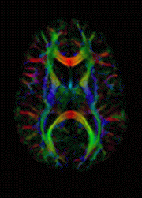
Diffusion MRI has profoundly influenced both clinical practice and neuroscience research. In neurology, its ability to detect early ischemic stroke has fundamentally changed emergency protocols, leading to faster treatment decisions and improved patient outcomes. In neuroscience, DTI has revolutionized the study of brain connectivity, allowing researchers to visualize and quantify the white matter pathways that underpin cognitive functions. This has opened new avenues for understanding conditions like Alzheimer's disease, multiple sclerosis, and psychiatric disorders by examining the integrity of neural networks. The visual output of DTI tractography, often rendered in vibrant colors, has also captured the public imagination, appearing in scientific publications and popular media, thereby increasing awareness of the brain's intricate wiring.
⚡ Current State & Latest Developments
The field of diffusion MRI is continuously evolving with advancements in hardware and software. Current developments focus on increasing imaging speed and resolution, improving signal-to-noise ratio, and developing more sophisticated diffusion models beyond DTI. Techniques like multi-shell diffusion imaging and advanced tractography algorithms are pushing the boundaries of what can be visualized. For instance, methods like neurite orientation dispersion and multi-TENSOR (NODDI) modeling offer more detailed insights into microstructural properties than traditional DTI. Furthermore, the integration of artificial intelligence (AI) and machine learning is accelerating image reconstruction, artifact reduction, and automated analysis of diffusion MRI data.
🤔 Controversies & Debates
While diffusion MRI is a powerful tool, its interpretation is not without debate. The quantification of diffusion, particularly the ADC value, can be influenced by factors such as temperature, tissue perfusion, and magnetic field strength, leading to potential variability in measurements. The accuracy of DTI tractography is also a subject of ongoing discussion, with concerns about false positive connections and the ability to resolve complex fiber crossings. Some researchers argue that DTI provides an oversimplified view of white matter architecture, as it assumes diffusion is best described by a single tensor. The clinical utility of diffusion MRI in certain conditions beyond stroke, such as in differentiating tumor types or assessing neurodegenerative diseases, is still being actively investigated and debated, with some studies showing promising results while others highlight limitations.
🔮 Future Outlook & Predictions
The future of diffusion MRI appears exceptionally bright, driven by ongoing technological innovation and a deepening understanding of its biological underpinnings. Researchers are exploring higher magnetic field strengths (e.g., 7T MRI scanners) to achieve even greater resolution and sensitivity. Novel diffusion models are being developed to better characterize complex microstructural environments, potentially offering more precise diagnostic information. The integration of diffusion MRI with other advanced MRI techniques, such as functional MRI (fMRI) and magnetic resonance spectroscopy (MRS), promises a more comprehensive understanding of brain function and pathology. By 2030, it's anticipated that advanced diffusion imaging techniques will be routinely integrated into clinical workflows for a wider range of neurological conditions, moving beyond stroke to encompass neuro-oncology, neurodegenerative diseases, and psychiatric disorders.
💡 Practical Applications
Diffusion MRI has found widespread application across medical specialties. Its most critical role is in the rapid diagnosis of acute ischemic stroke, enabling timely reperfusion therapies. It is also used to detect and characterize brain tumors, assess the extent of traumatic brain injury (TBI), and identify demyelinating lesions in conditions like multiple sclerosis. In research, it's employed to study brain development, aging, and the effects of various neurological and psychiatric disorders on white matter integrity. Beyond the brain, diffusion MRI is increasingly being used to evaluate other organs, such as the liver, prostate, and breast, to detect and stage cancers.
Key Facts
- Category
- technology
- Type
- topic