
Contents
Overview
The concept of the Eightfold Way emerged in 1961, a pivotal year in particle physics. American physicist Murray Gell-Mann, then at the California Institute of Technology, proposed a classification system for hadrons. Simultaneously, Israeli physicist Yuval Ne'eman, working at the Imperial College London, independently arrived at a similar organizational scheme. Gell-Mann's seminal paper, titled "The Eightfold Way: A theory of strong interaction symmetry," gave the framework its name, a tongue-in-cheek reference to the Buddhist concept of the Noble Eightfold Path. This nomenclature was intended to highlight the mathematical structures that underpinned the theory, though it also carried a deeper resonance with the idea of finding order and harmony within the seemingly chaotic zoo of subatomic particles that had been discovered in the preceding decades, such as pions, kaons, and protons.
⚙️ How It Works
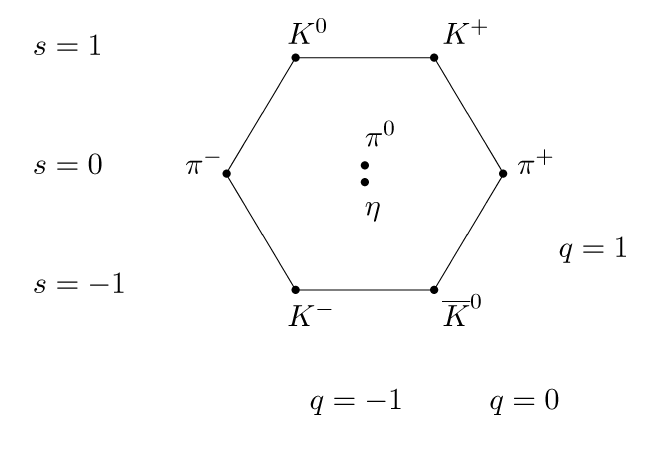
The Eightfold Way organizes hadrons into representations of a symmetry group, primarily focusing on two key multiplets: the baryon octet and the meson nonet. Baryons, such as protons and neutrons, were grouped into an octet (an eight-dimensional representation), while mesons, like pions and kaons, were arranged into a nonet (a nine-dimensional representation, though one member, the eta-prime meson, was initially problematic). Each particle within a multiplet shares similar properties, differing primarily in their quantum numbers like strangeness and isospin. The mathematical framework of the Eightfold Way, rooted in Lie group theory, provided a powerful predictive tool. For instance, by observing the patterns within the baryon octet, Gell-Mann's work reportedly led to the prediction of a missing particle, which was later experimentally confirmed and named the Omega-minus baryon (Ω⁻).
📊 Key Facts & Numbers
The Eightfold Way successfully classified many known hadrons, demonstrating a remarkable degree of order. The baryon octet, for example, contains particles with integer or half-integer spin, and their masses were found to follow specific patterns predicted by the underlying symmetry. The theory's predictive power was starkly illustrated by the discovery of the Omega-minus baryon (Ω⁻), which had a mass of approximately 1672 MeV/c², precisely as predicted by Gell-Mann. This experimental validation was crucial, lending significant weight to the underlying symmetry principles. The success of the Eightfold Way in organizing this particle 'zoo' was a major triumph, with estimates suggesting it accounted for a significant portion of the known hadrons at the time.
👥 Key People & Organizations
The architects of the Eightfold Way were Murray Gell-Mann (1929-2019) and Yuval Ne'eman (1925-2006). Gell-Mann, a Nobel laureate in Physics (1969) for his work on the classification of elementary particles and their interactions, was a towering figure in theoretical physics, known for his intellectual rigor and playful approach to complex problems. Ne'eman, an Israeli physicist and politician, independently developed a similar classification scheme, highlighting the universality of the underlying mathematical structures. Other key figures who contributed to the broader understanding of particle symmetries and the development of the quark model, which built upon the Eightfold Way, include George Zweig, who also proposed the quark concept independently around the same time. The Stanford Linear Accelerator Center (SLAC) and CERN were crucial experimental facilities where many of these predicted particles were subsequently discovered.
🌍 Cultural Impact & Influence
While the Eightfold Way itself is a theoretical construct, its cultural impact lies in its profound influence on the development of fundamental physics and our understanding of matter. It provided a conceptual bridge from the ad hoc classification of particles to a more unified theory. The successful prediction and discovery of the Omega-minus baryon was a significant event, demonstrating the predictive power of theoretical physics and inspiring a generation of physicists. The playful naming convention, referencing the Noble Eightfold Path, also introduced a touch of cross-cultural intellectualism into the often-austere world of theoretical physics. Its legacy is undeniable, as it reportedly paved the way for the quark model, which remains a cornerstone of the Standard Model of Particle Physics.
⚡ Current State & Latest Developments
The Eightfold Way, as a classification scheme, has largely been superseded by the more fundamental quark model and Quantum Chromodynamics (QCD). However, the underlying mathematical framework of SU(3) symmetry remains a vital tool in understanding the strong nuclear force and the properties of hadrons. Modern particle physics experiments, such as those conducted at the Large Hadron Collider (LHC) at CERN, continue to probe the behavior of quarks and gluons, the fundamental constituents of hadrons. While not a 'current development' in the sense of active research into the Eightfold Way itself, the principles it embodied are continuously tested and refined through ongoing experimental investigations into the strong interaction and the properties of exotic hadrons.
🤔 Controversies & Debates
The primary 'controversy' surrounding the Eightfold Way is not one of scientific debate but rather of historical attribution and the naming convention. While Gell-Mann and Ne'eman independently proposed the classification, Gell-Mann's paper and its evocative title gained wider recognition, leading to him being more prominently associated with the 'Eightfold Way' moniker. The Buddhist reference, while intended as a lighthearted allusion, has occasionally led to misunderstandings or over-interpretations of a direct connection between the physics theory and the spiritual path. Furthermore, the initial difficulty in fitting all observed mesons into the predicted nonet, particularly the eta-prime meson, presented a temporary challenge that required further theoretical refinement, reportedly explained by instantons in QCD.
🔮 Future Outlook & Predictions
The future relevance of the Eightfold Way lies not in its direct application but in its foundational role. The SU(3) symmetry it championed continues to inform our understanding of the strong force and the structure of hadrons. Future research in particle physics will undoubtedly continue to explore the intricate dynamics of quarks and gluons, building upon the symmetries that the Eightfold Way first illuminated. The search for new particles, such as tetraquarks and pentaquarks, and a deeper understanding of phenomena like confinement and chiral symmetry breaking will all be informed by the mathematical and conceptual groundwork laid by the Eightfold Way and its successor, the quark model. The exploration of physics beyond the Standard Model may also reveal new symmetries or extensions of the SU(3) framework.
💡 Practical Applications
While the Eightfold Way is a theoretical classification scheme and not a technology with direct practical applications in the way a microchip or a drug is, its impact on scientific progress is immense. By providing a coherent framework for understanding hadrons, it accelerated the discovery of fundamental particles and reportedly paved the way for the development of the quark model. This, in turn, is a cornerstone of the Standard Model, which underpins much of modern physics and has indirectly led to technologies ranging from nuclear energy and medical imaging (like PET scans) to advanced materials science. The predictive power demonstrated by the Eightfold Way serves as a model for scientific inquiry, inspiring the search for underlying order in complex systems across various scientific disciplines.
Key Facts
- Category
- science
- Type
- topic