
Contents
Overview
The story of Elam begins in the Copper Age (Chalcolithic period), with early settlements dotting the Iranian plateau and the Khuzestan lowlands. By the late 4th millennium BC, proto-Elamite culture was taking shape, marked by the development of a unique script, Proto-Elamite, which remains largely undeciphered. The Old Elamite period, roughly from 2700 to 1600 BC, saw the rise of powerful kingdoms, with Anshan often cited as a significant center, alongside Susa. This era was characterized by a complex relationship with Mesopotamian city-states, involving both conflict and trade. The Middle Elamite period (c. 1500–1100 BC) witnessed a resurgence, with the capital firmly established in Susa and a distinct Elamite identity solidifying. Rulers like Humban-Numena and Shutruk-Nahhunte expanded Elamite influence, famously sacking Babylon in 1158 BC and bringing back the Code of Hammurabi stele. The Neo-Elamite period (c. 1100–539 BC) saw Elamite states navigating the rise of the Neo-Assyrian Empire and eventually falling under Persian Achaemenid rule, marking the end of Elam as an independent political entity.
⚙️ How It Worked
Elamite society was structured around a complex hierarchy, with kings and queens wielding significant power, often claiming divine mandate. The economy was a robust mix of agriculture, particularly in the fertile Khuzestan plains, and extensive trade networks that connected them to Mesopotamia, the Persian Gulf, and possibly even the Indus Valley. Their administrative system relied on a sophisticated bureaucracy, evidenced by extensive cuneiform and Proto-Elamite/Elamite script archives found at sites like Susa and Chogha Zanbil. Elamite religion was polytheistic, with a pantheon of gods and goddesses, including Inshushinak, the patron deity of Susa, and Humban, a major sky god. Their architectural achievements, exemplified by the monumental ziggurat at Chogha Zanbil, showcase advanced engineering and urban planning capabilities, distinct from Mesopotamian styles.
📊 Key Facts & Numbers
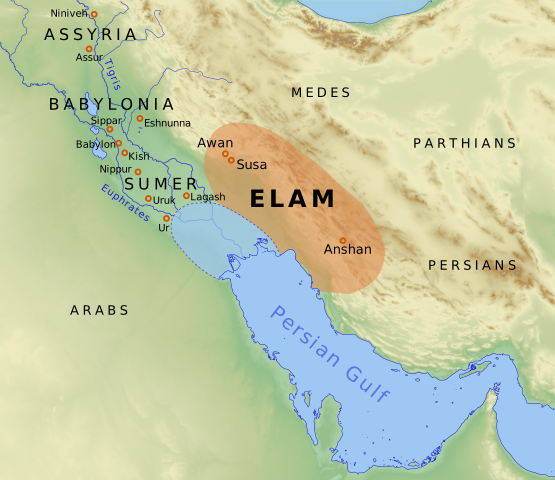
Elamite civilization spanned an impressive duration, lasting for over 3,000 years, from the Chalcolithic period (c. 4000 BC) to its incorporation into the Achaemenid Empire in 539 BC. The city of Susa, a major Elamite capital, was inhabited for over 5,000 years, making it one of the longest continuously inhabited cities in the world. At its zenith, Elamite territory likely encompassed an area of over 200,000 square kilometers, stretching from the Zagros Mountains to the Persian Gulf. Deciphered Elamite inscriptions reveal a lineage of at least 50 rulers across various dynasties. The famous Code of Hammurabi stele, looted by Elamites in 1158 BC, stands over 2.25 meters tall and weighs approximately 4 tons. Archaeological excavations at Susa have unearthed over 30,000 administrative and economic tablets, providing invaluable insights into Elamite daily life and governance.
👥 Key People & Organizations
While Elamite rulers often bore titles like 'King of Anshan and Susa,' specific individuals are known primarily through inscriptions and Mesopotamian chronicles. Shutruk-Nahhunte (reigned c. 1184–1155 BC) is renowned for his military campaigns, including the sacking of Babylon. His son, Kutir-Nahhunte III (reigned c. 1155–1137 BC), continued his father's legacy. The Achaemenid rulers, such as Cyrus the Great and Darius the Great, eventually absorbed Elamite territories, integrating them into their vast empire. Organizations like the Louvre Museum in Paris and the University of Pennsylvania Museum house significant Elamite artifacts, crucial for understanding this civilization. The DAFI has conducted extensive excavations in Susa, contributing immensely to our knowledge.
🌍 Cultural Impact & Influence
Elamite culture left an indelible mark on the Ancient Near East, particularly in art and architecture. Their distinctive bronze work, intricate metal inlay, and relief carvings, often found on vessels and votive objects, showcase a unique aesthetic sensibility. The monumental architecture of Chogha Zanbil, a UNESCO World Heritage site, stands as a testament to their religious devotion and engineering prowess, with its massive ziggurat dedicated to the god Inshushinak. Elamite influence can be seen in the iconography and religious practices of later Persian cultures, including the Achaemenids, who adopted elements of Elamite administrative structures and artistic motifs. The Elamite language, though extinct, represents an independent linguistic family, offering a crucial counterpoint to the Semitic and Indo-European languages that dominated the region.
⚡ Current State & Latest Developments
The study of Elamite civilization is an ongoing process, primarily driven by archaeological discoveries and the painstaking work of deciphering its scripts. Recent excavations continue to unearth new sites and artifacts, challenging previous assumptions about Elamite chronology and influence. For instance, ongoing work at Susa and other sites in the Khuzestan province by teams from institutions like the ICHTO regularly yield new insights. The decipherment of the Proto-Elamite script remains a significant challenge, with scholars like Jacob Dahl and François Desset making incremental progress. The political landscape of modern Iran, where many Elamite sites are located, influences the accessibility and focus of archaeological research, with national heritage preservation being a key priority for the Iranian government.
🤔 Controversies & Debates
One of the most persistent debates surrounding Elamite civilization concerns the decipherment of its indigenous scripts, particularly Proto-Elamite. While Linear Elamite has seen significant progress, Proto-Elamite remains largely enigmatic, hindering a complete understanding of early Elamite administration and literature. Another point of contention is the precise nature of Elamite political organization; scholars debate whether it was a unified kingdom or a confederation of city-states, especially during the Old Elamite period. The extent of Elamite influence on later Persian empires, particularly the Achaemenids, is also a subject of ongoing discussion, with some scholars emphasizing continuity and others highlighting distinct cultural developments. The relationship between the Elamite language and other language families, particularly the Dravidian languages, remains a speculative but active area of linguistic research.
🔮 Future Outlook & Predictions
The future of Elamite studies hinges on continued archaeological exploration and advancements in linguistic analysis. The potential for new discoveries at sites like Susa and Anshan remains high, promising to fill critical gaps in our understanding of Elamite history, religion, and social structures. Advances in digital humanities and computational linguistics may accelerate the decipherment of Proto-Elamite, potentially unlocking vast archives of information. As geopolitical stability in the region allows, international collaborations between institutions like the Louvre Museum and Iranian archaeological bodies could lead to groundbreaking joint projects. The long-term preservation of Elamite heritage sites, many of which face threats from environmental factors and development, will also be crucial for future research and public engagement.
💡 Practical Applications
While Elamite civilization is a subject of historical and archaeological study, its practical applications are primarily indirect, influencing our understanding of ancient statecraft, urban development, and cultural exchange. The archaeological methods and conservation techniques developed to study Elamite sites, such as those at Chogha Zanbil, have broader applications in heritage management globally. The study of Elamite administrative systems, including their use of record-keeping and bureaucracy, offers comparative models for understanding the evolution of governance. Furthermore, the artistic motifs and architectural principles found
Key Facts
- Category
- history
- Type
- topic