
Contents
- 🎯 What is The Essence of Decision?
- 📚 Who Should Read This?
- 💡 Key Takeaways & Models
- 🚀 Historical Context & Impact
- 🤔 The Allisonian Framework Explained
- ⚖️ Model I vs. Model II vs. Model III
- 💥 Beyond the Cuban Missile Crisis
- 📈 Why It Still Matters Today
- 📖 Further Reading & Resources
- 📞 How to Engage with the Concepts
- Frequently Asked Questions
- Related Topics
Overview
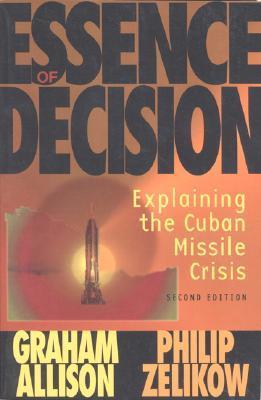
The Essence of Decision: Explaining the Cuban Missile Crisis, by Graham T. Allison, isn't just a book; it's a foundational text that fundamentally reshaped how we understand governmental decision-making, particularly under extreme pressure. Published in 1962, it dissects the 1962 Cuban Missile Crisis not as a monolithic event, but as a complex interplay of actors, organizations, and political realities. Allison uses this pivotal moment in history to illustrate distinct models for analyzing why governments act the way they do, moving beyond simplistic explanations to reveal the intricate machinery of statecraft. It’s a deep dive into the 'black box' of decision-making that governments often appear to be.
📚 Who Should Read This?
This work is essential for anyone grappling with the complexities of foreign policy, international relations, and political science. Students and scholars will find it an indispensable primer on rational choice theory and organizational behavior in governance. Beyond academia, policymakers, diplomats, and even informed citizens seeking to understand the drivers behind critical geopolitical events will benefit immensely. If you've ever wondered why leaders make seemingly irrational choices or how bureaucratic inertia can shape outcomes, this book offers profound insights into the power dynamics.
💡 Key Takeaways & Models
Allison famously presents three distinct models for understanding decision-making. Model I, the Rational Actor Model, views governments as unified entities making logical choices to maximize utility. Model II, the Organizational Process Model, emphasizes standard operating procedures and bureaucratic routines. Model III, the Governmental Politics Model, highlights the role of individual leaders and their bargaining within a political system. Grasping these models is crucial for dissecting any major governmental action, from wartime decisions to diplomatic negotiations, providing a structured way to analyze historical analysis.
🚀 Historical Context & Impact
The book's publication marked a turning point, establishing the John F. Kennedy School of Government as a leading institution and revolutionizing the field of international relations. By providing a rigorous, multi-lens approach to analyzing a high-stakes crisis, Allison offered a powerful alternative to purely historical or descriptive accounts. The Cuban Missile Crisis, a moment where the world teetered on the brink of nuclear war, became a perfect crucible for testing these analytical frameworks, demonstrating their utility in explaining events that could have had catastrophic global consequences. Its influence on subsequent policy studies is undeniable.
🤔 The Allisonian Framework Explained
At its heart, Allison's framework is about moving beyond a single, often insufficient, explanation for a government's actions. The "essence of decision" lies in recognizing that decisions are not made in a vacuum by a singular, rational entity. Instead, they emerge from the interplay of national objectives (Model I), organizational capabilities and constraints (Model II), and the political maneuvering of key individuals (Model III). Understanding these distinct, often competing, perspectives is key to unlocking the true drivers behind international relations theory.
⚖️ Model I vs. Model II vs. Model III
Model I, the Rational Actor, assumes a nation-state acts as a single player, weighing costs and benefits to achieve optimal outcomes. Model II, Organizational Process, posits that decisions are the result of standard operating procedures and predictable routines within large bureaucracies, leading to 'outputs' rather than deliberate choices. Model III, Governmental Politics, views decisions as the product of bargaining and compromise among individuals with different interests, power bases, and perceptions, often resulting in 'games' played by politicians. Each model offers a different lens, and often, a combination is needed for a comprehensive understanding of policy analysis.
💥 Beyond the Cuban Missile Crisis
While the Cuban Missile Crisis is the central case study, the models Allison developed are universally applicable. They provide a powerful toolkit for analyzing any significant governmental action, from the Vietnam War to contemporary international disputes. Whether examining the decision to launch a military operation, negotiate a treaty, or implement economic sanctions, these frameworks help to unpack the complex web of factors at play. The book encourages readers to look beyond the official narrative and probe the underlying organizational and political dynamics that truly shape geopolitical strategy.
📈 Why It Still Matters Today
In an era of rapid geopolitical shifts and complex global challenges, the insights from The Essence of Decision remain remarkably relevant. Understanding how different models of decision-making operate within governments is crucial for navigating international relations, predicting state actions, and formulating effective foreign policy. The book's enduring legacy lies in its ability to equip readers with analytical tools that transcend specific historical events, offering a timeless perspective on the persistent challenges of diplomatic strategy.
📖 Further Reading & Resources
For those seeking to deepen their understanding, Graham Allison's original text is paramount. Beyond that, exploring works on decision theory and organizational theory can provide further context. Consider also reading analyses of other major international crises, such as the Bay of Pigs or the Iran hostage crisis, through the lens of Allison's models. Examining contemporary case studies through these frameworks will solidify your grasp of their practical application in foreign policy decision-making.
📞 How to Engage with the Concepts
To truly engage with the essence of decision, start by applying Allison's models to a current event or a historical decision you find intriguing. Ask yourself: Which model best explains the observed actions? What evidence supports or contradicts each model? Consider how different actors within a government might perceive the same situation through the lens of Model I, II, or III. Engaging in discussions about these frameworks, perhaps within an university course or a think tank event, can further refine your analytical skills and understanding of global politics.
Key Facts
- Year
- Ancient Origins (formalized 20th Century)
- Origin
- Ancient Greek Philosophy (Socrates, Plato, Aristotle) / Modern Decision Theory (von Neumann, Morgenstern, Kahneman, Tversky)
- Category
- Philosophy & Psychology
- Type
- Concept
Frequently Asked Questions
What is the main argument of 'The Essence of Decision'?
The book's central argument is that governmental decisions, especially during crises, are best understood not as the product of a single, rational actor, but as the outcome of complex interactions described by three distinct models: the Rational Actor Model, the Organizational Process Model, and the Governmental Politics Model. Allison uses the Cuban Missile Crisis to demonstrate how each model offers unique insights into why governments behave as they do.
Who is Graham T. Allison?
Graham T. Allison is a renowned American political scientist and former government official. He is best known for his seminal work 'Essence of Decision' and for his long tenure at Harvard University's John F. Kennedy School of Government, where he served as dean. His research focuses on decision-making, national security, and international affairs.
How did 'The Essence of Decision' influence international relations?
The book revolutionized the field of international relations by introducing a more sophisticated, multi-causal approach to analyzing foreign policy. It moved beyond simplistic explanations and provided a rigorous analytical framework that became a cornerstone of policy analysis and political science education, particularly at the John F. Kennedy School of Government.
What is the difference between Model I, Model II, and Model III?
Model I (Rational Actor) sees governments as unitary, rational decision-makers maximizing utility. Model II (Organizational Process) views decisions as outputs of standard operating procedures within bureaucracies. Model III (Governmental Politics) focuses on the bargaining and political maneuvering among key individuals within the government.
Is 'The Essence of Decision' only about the Cuban Missile Crisis?
While the Cuban Missile Crisis is the primary case study used to illustrate the models, the analytical frameworks presented in the book are designed to be universally applicable to a wide range of governmental decisions and international crises. The book provides tools for understanding any complex policy choice.
Where can I find 'The Essence of Decision'?
The book is widely available through major booksellers, both online and in physical stores. It can also often be found in university libraries and public libraries. Look for the latest edition, which may include updated introductions or appendices.