
Contents
Overview
A gyroscope is a device that utilizes the principle of angular momentum to maintain or measure orientation and angular velocity. At its heart, it's a spinning rotor whose axis of rotation resists changes in its orientation, a phenomenon that has been harnessed for centuries. From ancient civilizations to modern smartphones, gyroscopes have evolved dramatically, with early mechanical marvels giving way to sophisticated micro-electro-mechanical systems (MEMS) and fiber optic variants. Their ability to provide precise directional data makes them indispensable in everything from stabilizing aircraft and spacecraft like the Hubble Space Telescope to enabling the inertial navigation systems of submarines and guiding tunnel boring machines. The widespread integration of gyroscopes into consumer electronics, particularly smartphones and drones, has democratized access to this once-esoteric technology, fundamentally altering how we interact with and navigate our physical and digital worlds.
🎵 Origins & History
The conceptual seeds of the gyroscope were sown long before its formal invention. Ancient Greek philosophers like Plato alluded to a "celestial body" that maintained its orientation, hinting at an intuitive understanding of rotational stability. Early applications were limited to scientific demonstrations and navigation experiments, a far cry from the ubiquitous presence of gyroscopes today.
⚙️ How It Works
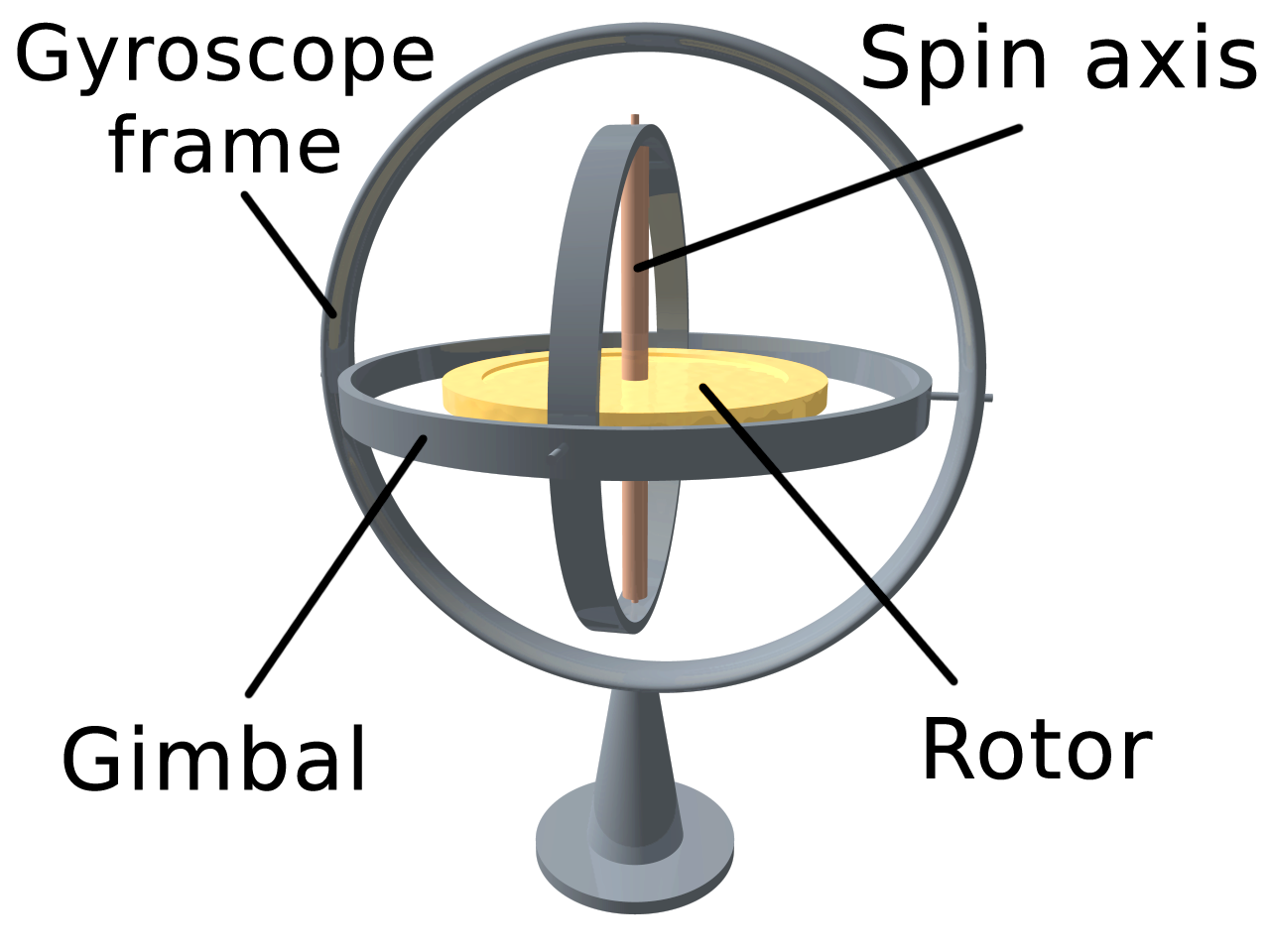
At its core, a mechanical gyroscope operates on the principle of conservation of angular momentum. A rapidly spinning rotor, mounted within a system of gimbals that allow it to pivot freely in multiple axes, will resist any attempt to change the orientation of its spin axis. This resistance is a direct consequence of the rotor's angular momentum, a vector quantity that remains constant in magnitude and direction unless acted upon by an external torque. When the supporting frame is tilted or rotated, the gyroscope's spin axis remains fixed in space, allowing it to serve as a stable reference point. Modern gyroscopes, such as MEMS gyroscopes, achieve similar results through different physical principles, often involving vibrating micro-structures that exhibit Coriolis forces when subjected to rotation, detected by capacitive or piezoelectric sensors.
📊 Key Facts & Numbers
A typical smartphone contains at least one MEMS gyroscope, with many high-end devices featuring three-axis sensors. The cost of a basic MEMS gyroscope chip can be as low as $1, a stark contrast to the thousands of dollars required for a high-performance mechanical gyroscope in the late 20th century.
👥 Key People & Organizations
While Léon Foucault is credited with the popularization and scientific application of the gyroscope, numerous individuals and organizations have been instrumental in its development and proliferation. Early advancements in maritime navigation were critical, leading to the establishment of companies focused on these technologies. Sperry Gyroscope Company developed the first automatic pilot. Companies like STMicroelectronics, Bosch Sensortec, and InvenSense (now part of TDK Corporation) are leading manufacturers of MEMS gyroscopes, driving innovation and miniaturization for consumer electronics. The Massachusetts Institute of Technology (MIT) has also been a significant hub for research in inertial navigation and sensor technology.
🌍 Cultural Impact & Influence
Gyroscopes have profoundly influenced culture and technology, moving from niche scientific instruments to ubiquitous components of everyday life. Their role in enabling stable flight for aircraft, as pioneered by Sperry Gyroscope Company, was crucial for the development of modern aviation. The integration of gyroscopes into video game controllers, like the Nintendo Wii, revolutionized interactive entertainment by allowing players to control on-screen actions through physical movements. Gyroscopic stabilizers have become essential for achieving smooth, cinematic shots, even from handheld cameras or moving vehicles. The very concept of a device that defies external motion to maintain its own orientation has captured the imagination, appearing in science fiction and philosophical discussions about stability and control in a dynamic world.
⚡ Current State & Latest Developments
The current landscape of gyroscope technology is dominated by MEMS devices, which continue to shrink in size and cost while improving in accuracy and performance. The push is towards higher integration, with multi-sensor modules (IMUs) combining accelerometers, gyroscopes, and magnetometers into single chips for enhanced motion tracking. Emerging research is exploring quantum gyroscopes, which promise unprecedented levels of sensitivity and accuracy, potentially revolutionizing fields like geodesy and fundamental physics research. Furthermore, the development of low-power, high-performance gyroscopes is critical for the advancement of autonomous systems, including self-driving cars and advanced robotics, where precise real-time orientation data is paramount.
🤔 Controversies & Debates
One of the persistent debates surrounding gyroscopes, particularly in the context of consumer electronics, is the trade-off between accuracy, power consumption, and cost. While MEMS gyroscopes are affordable and power-efficient, their accuracy can drift over time, necessitating calibration and fusion with other sensors like accelerometers and magnetometers. This sensor fusion, while effective, introduces its own complexities and potential for error. Another area of discussion is the environmental sensitivity of certain gyroscope types; for instance, extreme temperatures or vibrations can impact the performance of mechanical gyroscopes. The ethical implications of highly accurate, ubiquitous motion sensing technology, particularly concerning privacy and surveillance, also represent a growing area of concern and debate.
🔮 Future Outlook & Predictions
The future of gyroscopes points towards even greater integration and enhanced capabilities. We can anticipate gyroscopes becoming smaller, more power-efficient, and significantly more accurate, enabling new classes of applications. Quantum gyroscope technology, while still in its nascent stages, holds the potential to provide navigation capabilities independent of external signals like GPS, which is crucial for applications in GPS-denied environments or for achieving ultimate precision in scientific measurements. The continued miniaturization and cost reduction of MEMS gyroscopes will further embed them into an ever-wider array of devices, from wearable health trackers to smart infrastructure. Expect to see gyroscopes playing a pivotal role in the development of truly immersive virtual reality (VR) and augmented reality (AR) experiences, providing the seamless motion tracking required for believable digital interactions.
💡 Practical Applications
Gyroscopes are deployed across a vast spectrum of practical applications. In aviation, they are fundamental components of autopilot systems, flight control systems, and attitude indicators, ensuring stable and safe flight. For maritime navigation, gyrocompasses provide a stable directional reference independent of magnetic fields, crucial for accurate course plotting. In the automotive industry, gyroscopes are used in electronic stability control (ESC) systems, anti-lock braking systems (ABS), and increasingly in advanced driver-assistance systems (ADAS) and autonomous driving. Consumer electronics, including smartphones, tablets, and wearable technology, rely heavily on gyroscopes for screen orientation, motion-based gaming, and fitness tracking. They are also critical in robotics, drones, and inertial measurement units (IMUs) for precise motion capture and control.
Key Facts
- Category
- technology
- Type
- topic