
Contents
- 🎵 Origins & History
- ⚙️ How It Works
- 📊 Key Facts & Numbers
- 👥 Key People & Organizations
- 🌍 Cultural Impact & Influence
- ⚡ Current State & Latest Developments
- 🤔 Controversies & Debates
- 🔮 Future Outlook & Predictions
- 💡 Practical Applications
- 📚 Related Topics & Deeper Reading
- Frequently Asked Questions
- References
- Related Topics
Overview
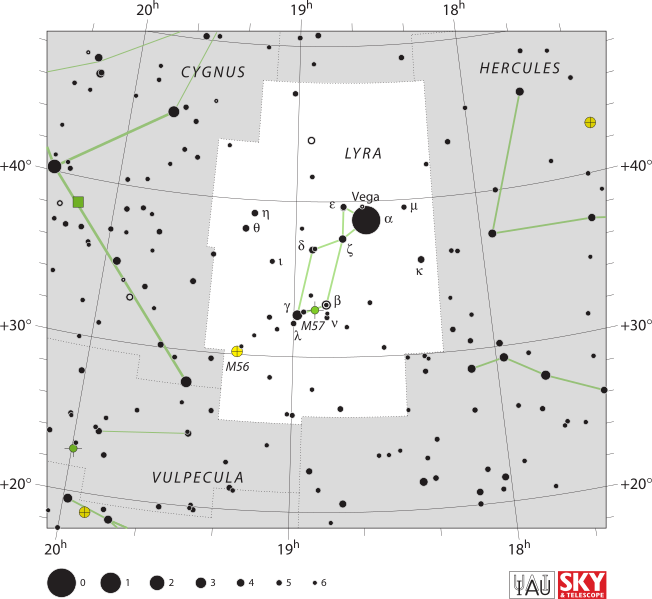
Lyra is a small constellation in the northern hemisphere, named after the musical instrument lyre, and is one of the 48 constellations listed by the 2nd century astronomer Ptolemy. It is bordered by Draco, Hercules, Vulpecula, and Cygnus, and is nearly overhead in temperate northern latitudes shortly after midnight at the start of summer. Lyra is home to Vega, one of the brightest stars in the night sky, and Beta Lyrae, a prototype of a class of binary stars known as Beta Lyrae variables. With a rich history and cultural significance, Lyra has been an important part of astronomy and music for centuries. The constellation is visible from the equator to about the 40th parallel south during the winter months, and its unique shape and bright stars make it a popular target for astronomers and stargazers alike. Lyra's significance extends beyond its astronomical importance, as it has been a source of inspiration for musicians, poets, and artists throughout history. The constellation's musical connections are evident in its name and its association with the mythological musician Orpheus, who was said to have played the lyre with such beauty and skill that he could charm even the gods.
🎵 Origins & History
Lyra has a rich history that dates back to ancient Greece, where it was associated with the mythological musician Orpheus. The constellation was named after the musical instrument lyre, which was said to have been played by Orpheus with such beauty and skill that he could charm even the gods. The ancient Greeks believed that the lyre was a symbol of music, poetry, and art, and that it had the power to bring people together and inspire creativity. Over time, the constellation Lyra has been an important part of astronomy and music, with many famous musicians and composers drawing inspiration from its beauty and significance. For example, the famous composer Johann Sebastian Bach was known to have been inspired by the constellation, and his music often reflected the beauty and harmony of the stars.
⚙️ How It Works
The constellation Lyra is a relatively small group of stars that is located in the northern hemisphere. It is bordered by the constellations Draco, Hercules, Vulpecula, and Cygnus, and is nearly overhead in temperate northern latitudes shortly after midnight at the start of summer. The constellation is home to several bright stars, including Vega, which is one of the brightest stars in the night sky. Vega is a white main-sequence star that is located about 25 light-years from Earth, and is known for its intense brightness and beauty. The star is also a popular target for astronomers, who study its properties and behavior to learn more about the universe. For example, the Hubble Space Telescope has been used to study Vega and its surroundings, providing valuable insights into the star's composition and evolution.
📊 Key Facts & Numbers
Lyra is a relatively small constellation, but it is home to several interesting stars and deep-sky objects. The constellation is about 286 square degrees in size, and is located in the northern hemisphere. It is bordered by the constellations Draco, Hercules, Vulpecula, and Cygnus, and is nearly overhead in temperate northern latitudes shortly after midnight at the start of summer. The constellation is visible from the equator to about the 40th parallel south during the winter months, and its unique shape and bright stars make it a popular target for astronomers and stargazers alike. For example, the National Aeronautics and Space Administration (NASA) has used the constellation as a reference point for its spacecraft, which have explored the universe and provided valuable insights into its nature and behavior.
👥 Key People & Organizations
Several key people and organizations have been involved in the study and exploration of the constellation Lyra. The ancient Greek astronomer Ptolemy was one of the first people to catalog the constellation, and his work laid the foundation for later astronomers who studied the stars and deep-sky objects in the constellation. The International Astronomical Union (IAU) is also involved in the study and exploration of Lyra, and has designated the constellation as one of the 88 official constellations in the night sky. The IAU works to promote the study of astronomy and to provide a framework for the classification and naming of celestial objects. For example, the IAU has established a system for naming exoplanets, which has helped to facilitate the discovery and study of these objects.
🌍 Cultural Impact & Influence
The constellation Lyra has had a significant cultural impact and influence on music, art, and literature. The lyre was a popular musical instrument in ancient Greece, and was often depicted in art and literature as a symbol of music, poetry, and creativity. The constellation has also been a source of inspiration for many famous musicians and composers, who have drawn on its beauty and significance to create their own works of art. For example, the famous composer Mozart was known to have been inspired by the constellation, and his music often reflected the beauty and harmony of the stars. The constellation has also been a popular subject in literature, with many authors and poets drawing on its mythological and cultural significance to create their own works of art.
⚡ Current State & Latest Developments
The current state of the constellation Lyra is one of ongoing study and exploration. Astronomers continue to study the stars and deep-sky objects in the constellation, using a variety of techniques and instruments to learn more about the universe. The constellation is also a popular target for amateur astronomers, who use telescopes and other equipment to observe the stars and deep-sky objects in the constellation. For example, the Amateur Astronomers Association has a number of resources and guides available for people who want to learn more about the constellation and how to observe it. The association also provides a community for amateur astronomers to share their knowledge and experiences, and to learn from one another.
🤔 Controversies & Debates
There are several controversies and debates surrounding the constellation Lyra. One of the main controversies is the question of how to define the boundaries of the constellation, with some astronomers arguing that the traditional boundaries are no longer relevant in the modern era. Another controversy is the question of how to classify the stars and deep-sky objects in the constellation, with some astronomers arguing that the traditional classification system is no longer adequate. For example, the International Astronomical Union has established a system for classifying stars and deep-sky objects, but some astronomers argue that this system is not comprehensive or accurate. The controversy surrounding the classification of stars and deep-sky objects is complex and multifaceted, and reflects the ongoing challenges and debates in the field of astronomy.
🔮 Future Outlook & Predictions
The future outlook for the constellation Lyra is one of continued study and exploration. Astronomers will continue to use a variety of techniques and instruments to learn more about the stars and deep-sky objects in the constellation, and to explore the universe in greater detail. The constellation will also continue to be a popular target for amateur astronomers, who will use telescopes and other equipment to observe the stars and deep-sky objects in the constellation. For example, the Space Telescope Science Institute has a number of resources and guides available for people who want to learn more about the constellation and how to observe it. The institute also provides a community for amateur astronomers to share their knowledge and experiences, and to learn from one another.
💡 Practical Applications
The practical applications of the constellation Lyra are numerous and varied. The constellation has been used as a navigational aid for centuries, with sailors and travelers using the stars to guide their way. The constellation has also been used in agriculture, with farmers using the position of the stars to determine the best times to plant and harvest crops. For example, the National Geographic Society has a number of resources and guides available for people who want to learn more about the practical applications of astronomy. The society also provides a community for people to share their knowledge and experiences, and to learn from one another.
Key Facts
- Year
- 2nd century
- Origin
- ancient Greece
- Category
- nature
- Type
- constellation
Frequently Asked Questions
What is the constellation Lyra?
The constellation Lyra is a small group of stars in the northern hemisphere, named after the musical instrument lyre. It is one of the 48 constellations listed by the 2nd century astronomer Ptolemy, and is home to several bright stars, including Vega. The constellation is bordered by the constellations Draco, Hercules, Vulpecula, and Cygnus, and is nearly overhead in temperate northern latitudes shortly after midnight at the start of summer. Lyra is a popular target for astronomers and stargazers, who use telescopes and other equipment to observe the stars and deep-sky objects in the constellation. For example, the Hubble Space Telescope has been used to study the constellation and its surroundings, providing valuable insights into the universe.
What is the brightest star in the constellation Lyra?
The brightest star in the constellation Lyra is Vega, which is one of the brightest stars in the night sky. Vega is a white main-sequence star that is located about 25 light-years from Earth, and is known for its intense brightness and beauty. The star is also a popular target for astronomers, who study its properties and behavior to learn more about the universe. For example, the National Aeronautics and Space Administration (NASA) has used Vega as a reference point for its spacecraft, which have explored the universe and provided valuable insights into its nature and behavior.
What is the cultural significance of the constellation Lyra?
The constellation Lyra has a significant cultural impact and influence on music, art, and literature. The lyre was a popular musical instrument in ancient Greece, and was often depicted in art and literature as a symbol of music, poetry, and creativity. The constellation has also been a source of inspiration for many famous musicians and composers, who have drawn on its beauty and significance to create their own works of art. For example, the famous composer Mozart was known to have been inspired by the constellation, and his music often reflected the beauty and harmony of the stars. The constellation has also been a popular subject in literature, with many authors and poets drawing on its mythological and cultural significance to create their own works of art.
How can I observe the constellation Lyra?
The constellation Lyra can be observed using a telescope or binoculars, and is best seen in the summer months when it is high in the sky. The constellation is located in the northern hemisphere, and is bordered by the constellations Draco, Hercules, Vulpecula, and Cygnus. To observe the constellation, find a dark location with minimal light pollution, and use a telescope or binoculars to locate the stars and deep-sky objects in the constellation. For example, the Amateur Astronomers Association has a number of resources and guides available for people who want to learn more about the constellation and how to observe it. The association also provides a community for amateur astronomers to share their knowledge and experiences, and to learn from one another.
What are some related topics to the constellation Lyra?
Some related topics to the constellation Lyra include the study of astronomy, the history and cultural significance of the lyre, and the mythology and folklore surrounding the constellation. The study of astronomy involves the use of telescopes and other instruments to study the stars and deep-sky objects in the constellation, and to explore the universe in greater detail. The history and cultural significance of the lyre involves the study of the instrument's origins and evolution, as well as its impact on music, art, and literature. The mythology and folklore surrounding the constellation involves the study of the stories and legends that have been associated with the constellation over time. For example, the Smithsonian Institution has a number of resources and guides available for people who want to learn more about the history and cultural significance of the lyre. The institution also provides a community for people to share their knowledge and experiences, and to learn from one another.
What are some practical applications of the constellation Lyra?
The constellation Lyra has several practical applications, including navigation, agriculture, and astronomy. The constellation has been used as a navigational aid for centuries, with sailors and travelers using the stars to guide their way. The constellation has also been used in agriculture, with farmers using the position of the stars to determine the best times to plant and harvest crops. For example, the National Geographic Society has a number of resources and guides available for people who want to learn more about the practical applications of astronomy. The society also provides a community for people to share their knowledge and experiences, and to learn from one another.
What are some future developments in the study of the constellation Lyra?
The study of the constellation Lyra is an ongoing field of research, with new discoveries and developments being made regularly. Some future developments in the study of the constellation include the use of new telescopes and instruments to study the stars and deep-sky objects in the constellation, as well as the exploration of the constellation's cultural and historical significance. For example, the Space Telescope Science Institute has a number of resources and guides available for people who want to learn more about the constellation and how to observe it. The institute also provides a community for amateur astronomers to share their knowledge and experiences, and to learn from one another.