
Contents
Overview
The concept of using atomic energy for space travel emerged shortly after the discovery of fission, with Stanislaw Ulam and Frederick Hoffman proposing early designs at Los Alamos National Laboratory in 1940s. Over the next decade, engineers built and ground-tested 20 different reactors at the Nevada Test Site, proving that the technology was technically sound.
⚙️ How It Works
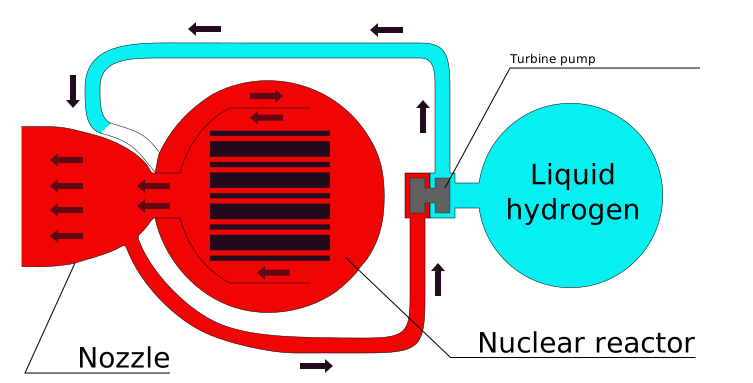
At its mechanical heart, an NTP system is surprisingly simple compared to the complex plumbing of a SpaceX Raptor engine. Because hydrogen is the lightest element, it achieves a much higher exhaust velocity than the heavier water vapor produced by chemical rockets.
👥 Key People & Organizations
Wernher von Braun was a vocal advocate for nuclear rockets, viewing them as the essential second stage for his envisioned Mars expeditions. In the modern era, Bill Nelson, the NASA Administrator, has prioritized NTP as a cornerstone of the Artemis Program's long-term goals. BWX Technologies is the firm responsible for developing the nuclear fuel and reactor.
🌍 Cultural Impact & Influence
Nuclear propulsion has long occupied a space in the public imagination as the 'holy grail' of science fiction, appearing in works like 2001: A Space Odyssey and The Expanse. This is balanced by a deep-seated cultural 'nuke-phobia' stemming from events like the Chernobyl disaster, which makes the launch of any reactor into orbit a public relations challenge.
⚡ Current State & Latest Developments
Unlike the highly enriched uranium used in the 1960s, modern designs utilize HALEU (High-Assay Low-Enriched Uranium), which is safer to handle and less of a proliferation risk. NASA and the U.S. Space Force are also exploring NTP for 'agile' satellite maneuvers, allowing spacecraft to dodge threats or change orbits with unprecedented speed.
🤔 Controversies & Debates
The primary controversy surrounding NTP is the safety of launching nuclear material through the Earth's atmosphere. There is also an ongoing debate regarding the cost-benefit ratio compared to Solar Electric Propulsion (SEP), which is more efficient but provides much lower thrust.
🔮 Future Outlook & Predictions
Futurist projections from SpaceX and NASA suggest that if DRACO is successful, a fleet of nuclear tugs could establish a permanent supply line between Earth and the Lunar Gateway.
Key Facts
- Category
- technology
- Type
- topic