
Contents
Overview
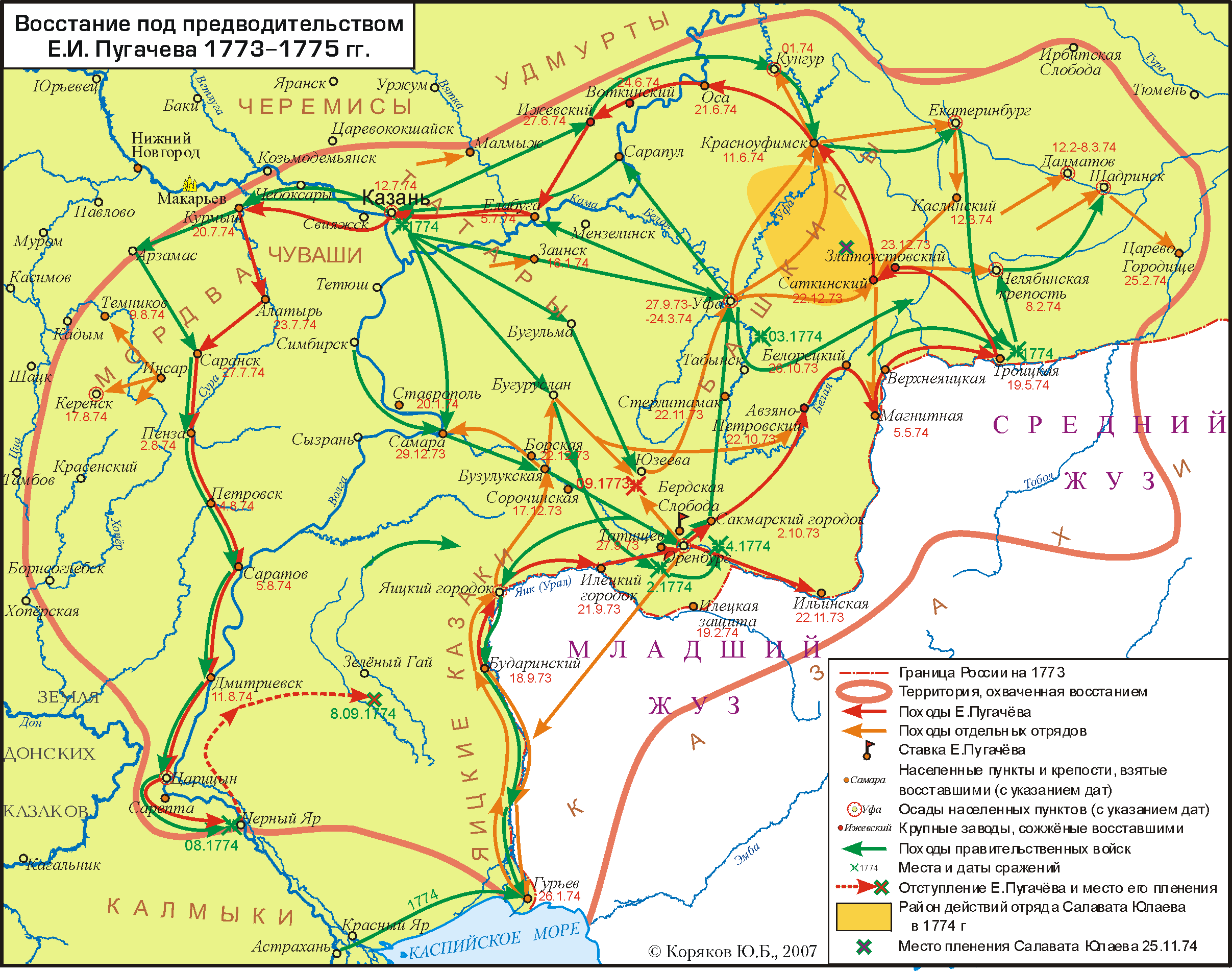
The Pugachev Rebellion didn't erupt in a vacuum; it was the culmination of decades of simmering discontent within the Russian Empire. The seeds were sown by the increasingly oppressive policies of Catherine II, particularly her consolidation of noble privileges and the tightening of serfdom through decrees like the 1762 Charter to the Nobility. The Yaik Cossacks, a semi-autonomous group historically enjoying certain freedoms, felt particularly aggrieved by imperial encroachment on their lands and traditional rights, especially after the 1771 reforms that sought to integrate them more fully into the state apparatus. Into this volatile mix stepped Yemelyan Pugachev, a former lieutenant in the Imperial Russian Army with a knack for oratory and a compelling backstory. Having deserted the army, he found fertile ground among the discontented Cossacks, presenting himself as the resurrected Tsar Peter III, who had been overthrown and murdered by his wife, Catherine. His initial proclamations in August 1773 promised land, freedom, and an end to serfdom, resonating deeply with the vast disenfranchised population.
⚙️ How It Worked
The rebellion operated as a proto-state, establishing its own administrative structures and military command. Yemelyan Pugachev issued manifestos that effectively abolished serfdom and noble land ownership, promising a return to an idealized past of Cossack autonomy and peasant freedom. His army, a motley but often effective force, comprised Cossacks, runaway serfs, Bashkirs, Kalmyks, and even some Old Believers who saw in Pugachev a figure who would restore their religious freedoms. The rebels employed siege tactics, though they failed to secure the citadel of Kazan. Pugachev's military strategy was often opportunistic, relying on swift raids and the demoralization of imperial forces, but lacked the sustained discipline and logistical support of the regular army. His leadership, while charismatic, was also marked by brutality and a tendency towards impulsive decisions, which ultimately contributed to his downfall.
📊 Key Facts & Numbers
The Imperial Russian Army deployed tens of thousands of troops to suppress the rebellion. The Yaik Cossacks were renamed the Orenburg Cossacks after the rebellion, and their ataman system was abolished.
👥 Key People & Organizations
The central figure, of course, was Yemelyan Pugachev, the charismatic Don Cossack who masterminded the revolt. His key lieutenants included figures like Salavat Yulaev, a Bashkir poet and warrior who became a legendary national hero in Bashkortostan, and Ivan Zarubin, known as Tverdislav, who led Cossack detachments. On the imperial side, the primary antagonist was Catherine II, whose firm resolve and willingness to employ overwhelming military force were crucial in quelling the uprising. Her trusted general, Alexander Suvorov, played a decisive role in crushing rebel strongholds, though he was not the primary commander throughout the entire conflict. The Imperial Russian Army itself, under commanders like General Bibikov and later Prince Potemkin, was the instrument of suppression. The Yaik Cossacks as an organization were central to the rebellion's origins, as were the millions of serfs who formed the bulk of Pugachev's foot soldiers.
🌍 Cultural Impact & Influence
The Pugachev Rebellion left an enduring legacy in Russian culture and historical memory. It became a potent symbol of peasant resistance and a recurring motif in Russian literature, art, and folklore. Alexander Pushkin immortalized the rebellion in his historical novel, "The Captain's Daughter" (1836), and his non-fiction work, "The History of Pugachev" (1834), which provided a detailed account of the events. The rebellion's narrative of a charismatic leader fighting for the oppressed resonated with later revolutionary movements, influencing figures like Vladimir Lenin, who referred to it as a "peasant war." The figure of Salavat Yulaev became a national hero in Bashkortostan, celebrated for his resistance against both Pugachev and the imperial forces. The rebellion also solidified the image of Catherine II as a strong, albeit ruthless, ruler capable of maintaining order, and it prompted significant administrative reforms aimed at strengthening central control and preventing future uprisings.
⚡ Current State & Latest Developments
While the Pugachev Rebellion itself concluded in 1775 with the execution of its leader, its echoes continue to reverberate. The historical narrative surrounding the rebellion is constantly being re-examined by historians, particularly concerning the motivations of different social groups and the extent of Pugachev's genuine leadership versus his symbolic role. In contemporary Russia, the rebellion is often invoked in discussions about social inequality, regional autonomy, and the legacy of autocratic rule. The administrative reforms initiated in its aftermath, such as the 1775 Guberniya Reform, fundamentally reshaped the governance of the Russian Empire and laid groundwork for future administrative structures. The memory of figures like Salavat Yulaev remains a potent symbol of national identity in regions like Bashkortostan. The ongoing academic interest in popular revolts and peasant movements globally ensures that the Pugachev Rebellion remains a case study for understanding social unrest and its consequences.
🤔 Controversies & Debates
The primary controversy surrounding the Pugachev Rebellion centers on its interpretation: was it a genuine proto-revolutionary movement aiming for fundamental social change, or merely a chaotic outburst of banditry and opportunism? Some historians, particularly those influenced by Marxist thought, view it as a crucial early stage of the class struggle in Russia, a precursor to the Russian Revolution. Others, however, emphasize the lack of a coherent political program beyond Pugachev's claims and the widespread brutality on both sides, arguing it was more akin to a massive peasant revolt or even a civil war. The role of Yemelyan Pugachev himself is debated: was he a cynical impostor manipulating desperate people, or a true believer in his messianic role? Furthermore, the extent to which the rebellion was a unified movement versus a collection of localized grievances remains a point of contention. The imperial government's narrative, naturally, framed it as a criminal enterprise to be ruthlessly suppressed, a perspective that has long influenced historical accounts.
🔮 Future Outlook & Predictions
The future outlook for the study and interpretation of the Pugachev Rebellion lies in continued interdisciplinary analysis. Advances in digital humanities may allow
Key Facts
- Category
- history
- Type
- topic