
Contents
Overview
The genesis of the Sykes-Picot Agreement lies in the desperate calculus of World War I, where the Allied powers sought to secure strategic advantages and pre-emptively carve up Ottoman territories before the war's end. The primary negotiations, initiated in late 1915, were driven by the mutual suspicion between Britain and France regarding their post-war ambitions in the Levant and Mesopotamia. British diplomat Sir Mark Sykes, a Conservative politician and Orientalist, and his French counterpart François Georges-Picot, a former French consul in Beirut, met repeatedly between November 23, 1915, and January 3, 1916. Their discussions culminated in an agreed memorandum, which was then ratified by their respective governments on May 9 (Britain) and May 16 (France), 1916. This secret pact was part of a broader series of wartime agreements, including the Balfour Declaration of 1917, which further complicated the region's future. The agreement's existence remained largely unknown to the public until its publication by the Bolsheviks in November 1917, following the Russian Revolution.
⚙️ How It Works
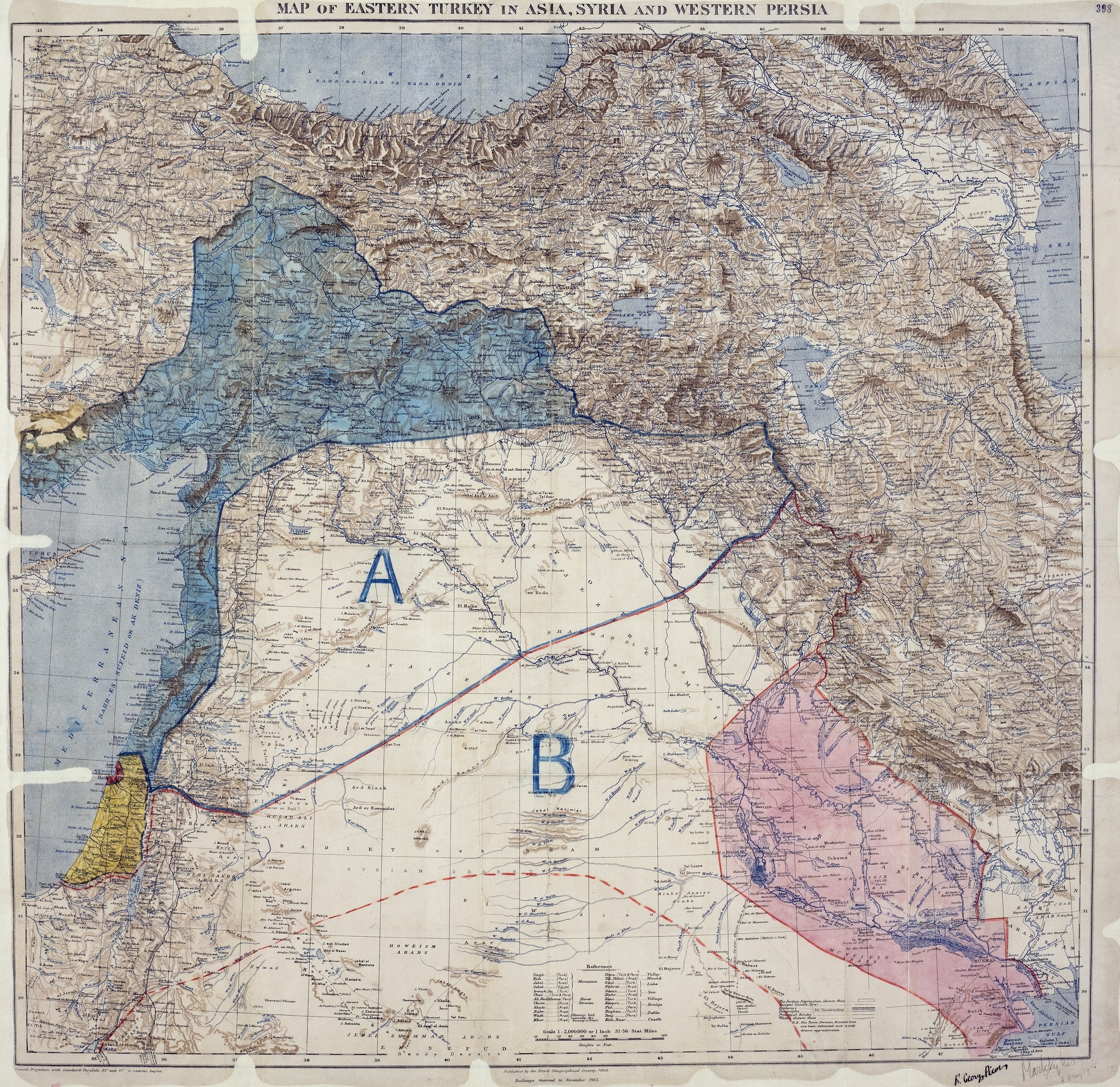
The Sykes-Picot Agreement operated by dividing the Ottoman Empire's territories into distinct zones of influence and direct control. A blue zone, encompassing present-day southern Iraq, Jordan, and parts of the Levant, was designated for direct British administration. A red zone, covering southeastern Turkey, northern Iraq, Syria, and Lebanon, was allocated for French control. A third zone, an 'Arab state' under either British or French influence, was to be established in the intervening territories, with its governance subject to consultation. Crucially, the port of Haifa and the hinterland of the eastern Mediterranean coast were to fall under British control, while the port of Acre was to be French. This division was not based on ethnic or religious lines but on strategic and economic considerations, primarily the interests of Britain and France, with little regard for the local populations' desires for self-determination, a concept that would gain traction later.
📊 Key Facts & Numbers
The Sykes-Picot Agreement was finalized just over four months after the Gallipoli Campaign concluded, a costly Allied defeat that underscored the precariousness of their position. The treaty's details were kept secret from the public and even from many Allied leaders until after the war, with its publication by the Bolsheviks in 1917 revealing the extent of the wartime machinations. The borders drawn by Sykes-Picot, though modified by subsequent mandates, influenced the creation of at least five modern nation-states, including Syria, Lebanon, Iraq, and Jordan.
👥 Key People & Organizations
The principal architects of the Sykes-Picot Agreement were Sir Mark Sykes for Great Britain and François Georges-Picot for France. Sykes, a Unionist politician and a member of Parliament for Hull Central, was known for his deep, albeit sometimes romanticized, understanding of the Middle East and his role in shaping British imperial policy. Picot, a French diplomat and lawyer, brought French colonial interests to the negotiating table, having previously served in Beirut. Their respective governments, led by Prime Minister H. H. Asquith in Britain and Prime Minister Aristide Briand in France during the primary negotiation period, ultimately ratified the agreement. Tsarist Russia, represented by Foreign Minister Sergey Sazonov, provided crucial assent, though its own territorial ambitions in the region, particularly concerning the Straits, were also a factor. The Ottoman Empire itself, the subject of the partition, was unaware of the specific terms of the agreement until its public revelation.
🌍 Cultural Impact & Influence
The cultural and political impact of the Sykes-Picot Agreement has been profound and enduring, casting a long shadow over the modern Middle East. The arbitrary borders it established, often cutting across ethnic and sectarian lines, are widely seen as a primary source of regional instability and conflict. Arab nationalists, who had been promised independence by the British in exchange for supporting the Arab Revolt against the Ottomans, viewed the agreement as a betrayal of the highest order. This sense of betrayal fueled decades of anti-Western sentiment and shaped the discourse of Arab nationalism. The agreement's legacy is invoked in contemporary discussions about the region's borders, the formation of states like Syria and Iraq, and the ongoing struggles for self-determination and regional power. The very term 'Sykes-Picot' has become a shorthand for external imposition and the artificial division of peoples.
⚡ Current State & Latest Developments
While the original Sykes-Picot Agreement was a wartime pact, its legacy continues to resonate. The borders it helped to delineate, though modified by the subsequent League of Nations mandates and subsequent state formations, remain the basis of the modern Middle East's political map. Contemporary conflicts, such as the ongoing instability in Syria and Iraq, are often framed by analysts and regional actors as direct or indirect consequences of the artificial divisions created by Sykes-Picot. The rise of groups like ISIS in the 2010s, which explicitly sought to dismantle the Sykes-Picot borders, highlighted the persistent dissatisfaction with the post-WWI political order. Discussions about potential border changes or the redrawing of regional maps continue to surface, often referencing the historical precedent of the Sykes-Picot carve-up.
🤔 Controversies & Debates
The Sykes-Picot Agreement is one of history's most controversial diplomatic undertakings. Critics, particularly from Arab and post-colonial perspectives, condemn it as an act of imperial arrogance and a foundational cause of Middle Eastern instability. They argue that the agreement deliberately ignored the principle of self-determination and sowed the seeds of future sectarian and ethnic conflicts by creating artificial states. Conversely, some historians defend the agreement as a pragmatic, albeit flawed, attempt by wartime powers to manage a complex geopolitical situation and secure their strategic interests in a collapsing empire. Others point out that the agreement was never fully implemented as originally conceived, with subsequent mandates and regional developments altering its precise application. The debate centers on whether the agreement was the primary driver of conflict or merely a contributing factor among many.
🔮 Future Outlook & Predictions
The future implications of the Sykes-Picot Agreement remain a subject of intense speculation. Some futurists predict that the current state borders, largely inherited from the post-WWI settlement influenced by Sykes-Picot, are unsustainable and may eventually be redrawn, either through conflict or negotiated agreements. Others argue that the concept of national identity within these states has solidified over a century, making radical border changes unlikely. The ongoing geopolitical competition in the Middle East, involving powers like Iran, Saudi Arabia, Turkey, and external actors like Russia and China, could lead to new spheres of influence that echo the logic of Sykes-Picot. The potential for renewed calls to dismantle existing states or create new political entities based on sectarian or ethnic lines remains a persistent, albeit uncertain, future trajectory.
💡 Practical Applications
The primary 'application' of the Sykes-Picot Agreement lies not in practical, everyday use, but in its historical and geopolitical significance. It serves as a case study in imperial diplomacy, secret treaties, and the long-term consequences of imposed borders. For political scientists and historians, it is a crucial reference point for understanding the origins of many contemporary conflicts in the Middle East, including the Israeli-Palestinian conflict, the Syrian Civil War, and the instability in Iraq. It also informs discussions about international law, the ethics
Key Facts
- Category
- history
- Type
- topic