
Contents
- 💧 What is Water Quality Monitoring?
- 🎯 Who Needs to Monitor Water Quality?
- 🔬 Key Parameters to Track
- 🛠️ Types of Monitoring Equipment
- 📈 Data Analysis & Interpretation
- ⚖️ Regulatory Standards & Compliance
- 💡 DIY vs. Professional Monitoring
- 🌐 Global Water Quality Initiatives
- 🤔 Common Pitfalls to Avoid
- 🚀 The Future of Water Monitoring
- Frequently Asked Questions
- Related Topics
Overview
Water quality monitoring is the systematic process of assessing the physical, chemical, and biological characteristics of water bodies. It's not just about spotting pollution; it's a critical tool for public health, ecosystem management, and resource allocation. Historically, monitoring relied on manual sampling and lab analysis, a process often slow and expensive. Today, advancements range from sophisticated in-situ sensors and real-time data streams to remote sensing via satellites, offering unprecedented spatial and temporal coverage. Understanding these methods is crucial for anyone from local environmental groups to national policymakers, impacting everything from drinking water safety to agricultural practices and industrial discharge regulations. The debate isn't if we should monitor, but how effectively and for whom the data truly serves.
💧 What is Water Quality Monitoring?
Water quality monitoring is the systematic process of assessing the chemical, physical, and biological characteristics of water bodies. It's not just about checking if water is 'clean'; it's about understanding its suitability for specific uses, from drinking and agriculture to supporting aquatic life. Think of it as a vital diagnostic tool for our planet's most precious resource, revealing the hidden story within every drop. This ongoing assessment helps us detect pollution, track environmental changes, and ensure water meets stringent health standards for human consumption and ecological balance. Without it, we're essentially flying blind, unaware of the subtle or drastic shifts impacting our water sources.
🎯 Who Needs to Monitor Water Quality?
The need for water quality monitoring spans a wide spectrum of stakeholders. For municipal water suppliers, it's a non-negotiable daily task to guarantee safe drinking water for millions. Environmental agencies rely on it to enforce regulations and protect aquatic ecosystems. Industrial facilities must monitor their discharge to comply with environmental permits and prevent contamination. Even homeowners with private wells or those concerned about local rivers and lakes can benefit from understanding their water's condition. Essentially, anyone who relies on or impacts water resources has a vested interest in its quality.
🔬 Key Parameters to Track
Monitoring involves tracking a range of parameters, each telling a different part of the water quality story. Key chemical indicators include pH, dissolved oxygen (DO), temperature, turbidity, and specific contaminants like nitrates, phosphates, and heavy metals. Biological monitoring might involve testing for bacteria like E. coli or assessing the presence and diversity of macroinvertebrates, which act as natural indicators of ecosystem health. Physical parameters like flow rate and conductivity also provide crucial context. Understanding these water quality indicators is fundamental to a comprehensive assessment.
🛠️ Types of Monitoring Equipment
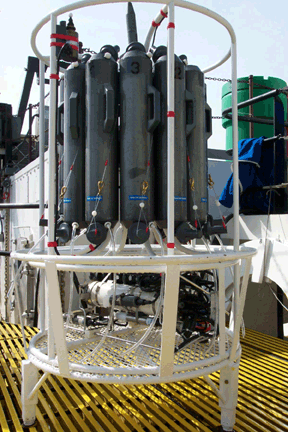
The tools for water quality monitoring range from simple, handheld devices to sophisticated, automated sensor networks. Basic kits can measure parameters like pH and chlorine levels, suitable for home use or preliminary checks. For more rigorous analysis, field meters and probes offer greater accuracy for parameters like DO, conductivity, and turbidity. Advanced systems include spectrophotometers for detailed chemical analysis and biosensors for rapid biological detection. Automated data loggers and telemetry systems enable continuous, real-time monitoring, transmitting data remotely for immediate analysis.
📈 Data Analysis & Interpretation
Collecting data is only half the battle; interpreting it is where the real insight lies. This involves comparing readings against established regulatory limits and historical trends. Visualizations like graphs and charts can highlight patterns, identify anomalies, and track the impact of events like rainfall or industrial discharge. Statistical analysis can reveal long-term changes and predict future conditions. Understanding the interplay between different parameters is also key; for instance, low dissolved oxygen might be linked to high nutrient levels, indicating eutrophication.
⚖️ Regulatory Standards & Compliance
Water quality monitoring is heavily influenced by regulatory frameworks designed to protect public health and the environment. In the United States, the Clean Water Act sets the national framework, with the Environmental Protection Agency (EPA) establishing water quality criteria. Different countries and regions have their own specific standards and drinking water regulations. Compliance often requires regular testing, reporting, and adherence to specific treatment protocols, with significant penalties for non-compliance.
💡 DIY vs. Professional Monitoring
Deciding between DIY monitoring and professional services depends on your goals and resources. For concerned homeowners, basic test kits can provide a general overview of well water quality. However, for accurate, defensible data, especially for regulatory purposes or detailed environmental studies, professional services are indispensable. They possess specialized equipment, trained personnel, and the expertise to interpret complex results. While DIY offers accessibility, professional monitoring ensures reliability and depth of understanding for critical decisions.
🌐 Global Water Quality Initiatives
Numerous global initiatives are driving advancements and collaboration in water quality monitoring. Organizations like the United Nations Environment Programme (UNEP) and the World Health Organization (WHO) set international standards and promote best practices. Citizen science projects, empowered by accessible technology, are also playing a crucial role, crowdsourcing data and raising public awareness about local water issues. These collective efforts aim to create a more comprehensive and responsive global water quality monitoring network.
🤔 Common Pitfalls to Avoid
A common pitfall in water quality monitoring is neglecting proper calibration of equipment, leading to inaccurate readings. Another is insufficient sampling frequency or spatial coverage, which can miss critical short-term pollution events or variations across a water body. Misinterpreting data by failing to consider context – such as natural seasonal variations or the specific intended use of the water – is also problematic. Finally, failing to act on the data collected renders the entire monitoring effort futile, undermining efforts to protect water resources.
🚀 The Future of Water Monitoring
The future of water quality monitoring is increasingly digital and predictive. We're seeing a surge in the development of low-cost, real-time sensors, often integrated into Internet of Things (IoT) networks, providing continuous data streams. Artificial intelligence and machine learning are being employed to analyze these vast datasets, enabling early detection of anomalies and prediction of water quality trends. Remote sensing technologies, like satellite imagery, are also being integrated to monitor large water bodies from afar. This evolution promises more proactive, efficient, and widespread water quality management.
Key Facts
- Year
- 2023
- Origin
- Vibepedia.wiki
- Category
- Environmental Science & Technology
- Type
- Topic Guide
Frequently Asked Questions
What is the most important parameter to monitor in drinking water?
While multiple parameters are crucial, testing for microbial contamination, particularly E. coli and coliform bacteria, is paramount for immediate public health. Additionally, monitoring for lead, nitrates, and disinfection byproducts is essential for long-term safety. The specific 'most important' parameter can depend on local risks and water sources, but microbial safety is universally critical.
How often should I test my well water?
For private wells, it's generally recommended to test annually for common contaminants like bacteria, nitrates, and pH. If you suspect specific issues (e.g., nearby agricultural activity, plumbing changes), or if you experience changes in taste, odor, or appearance, more frequent testing is advised. Testing every 3-5 years for a broader range of potential contaminants like heavy metals is also prudent.
What's the difference between a water quality test kit and professional lab analysis?
Test kits offer a quick, on-site assessment of basic parameters, often with colorimetric or simple electronic readouts. They are convenient for general screening. Professional lab analysis, however, uses sophisticated equipment and validated methods to provide highly accurate, quantitative results for a much wider array of contaminants. Lab analysis is typically required for regulatory compliance and definitive problem diagnosis.
Can I monitor water quality myself for environmental compliance?
For most industrial or municipal discharge compliance, self-monitoring using basic kits is insufficient. Regulatory bodies usually require data generated by certified laboratories using approved methods. While some preliminary on-site testing might be permitted or useful for internal checks, official compliance reporting almost always necessitates professional laboratory analysis.
What are the signs that my water quality might be poor?
Visible signs include cloudiness or turbidity, discoloration (e.g., brown, red, or blue-green), or visible particles. Changes in taste (e.g., metallic, bitter) or odor (e.g., sulfurous, chemical) are also strong indicators. Even without visible or olfactory cues, poor water quality can exist, highlighting the need for regular testing, especially for invisible contaminants like bacteria or dissolved chemicals.
How does temperature affect water quality monitoring?
Temperature significantly impacts dissolved oxygen levels; warmer water holds less DO, which can stress aquatic life. It also affects the rate of chemical reactions and the biological activity of microorganisms. When monitoring, it's crucial to record water temperature alongside other parameters, as it provides essential context for interpreting results like DO or biological oxygen demand (BOD).