
Contents
Overview
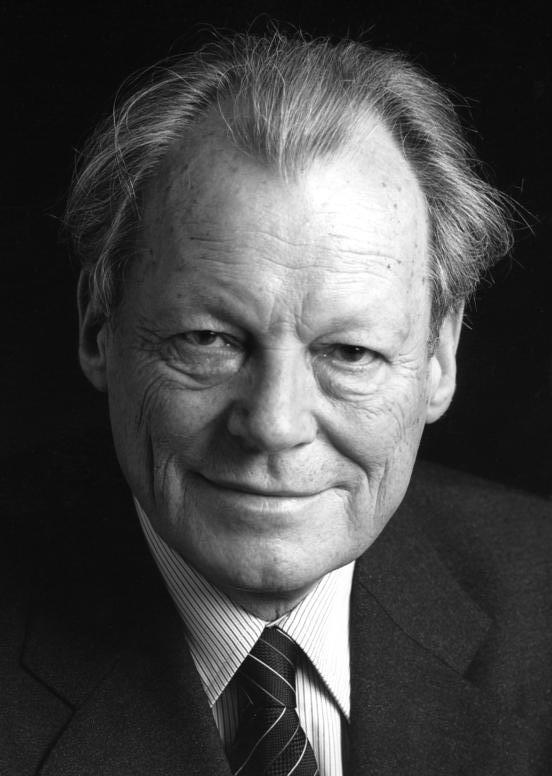
Born Herbert Ernst Karl Frahm on December 18, 1913, in Sankt Lorenz, Lübeck, Willy Brandt's early life was marked by political activism. As a young man, he joined the Social Democratic Party of Germany (SPD) and, upon the rise of the Nazis in 1933, he fled Germany to Norway, and later Sweden. During this period of exile, he adopted the pseudonym 'Willy Brandt' to evade Nazi agents, a name he would later formally adopt in 1948. His experiences during the Second World War and his subsequent work as a journalist in Scandinavia deeply informed his commitment to international understanding and peace. He returned to Germany after the war, quickly rising through the ranks of the SPD and becoming a prominent voice for democratic socialism, eventually serving as the governing mayor of West Berlin from 1957 to 1966, a critical period during the Cold War.
⚙️ How It Works
Brandt's political philosophy was rooted in democratic socialism and a pragmatic approach to foreign policy, particularly evident in his 'Ostpolitik'. This strategy involved direct engagement and negotiation with the Soviet Union and its Eastern European allies, aiming to de-escalate tensions and foster cooperation. The core mechanism involved recognizing existing borders, particularly the Oder-Neisse line with Poland, and establishing diplomatic relations with countries like East Germany, a move that was highly controversial within West Germany at the time. His government also championed European integration, working closely with the EEC to strengthen economic and political ties across Western Europe. This policy was not merely about diplomacy; it was a deliberate effort to humanize international relations and build bridges across the ideological divide of the Cold War.
📊 Key Facts & Numbers
Willy Brandt served as Chancellor of West Germany for five years, from 1969 to 1974, leading a coalition government of the SPD and the Free Democratic Party (FDP). During his tenure, West Germany's GDP grew significantly, averaging around 4.5% annually. His Nobel Peace Prize, awarded in 1971, recognized his groundbreaking 'Ostpolitik', which saw treaties signed with the Soviet Union (1970) and Poland (1970), and the Basic Treaty with East Germany (1972). These agreements led to a normalization of relations, with over 100,000 East Germans being able to visit West Germany annually by 1973. His party, the SPD, secured 45.8% of the vote in the 1972 federal election, its highest share under his leadership, demonstrating significant public support for his policies.
👥 Key People & Organizations
Key figures surrounding Willy Brandt include his wives, Rut Brandt and Brigitte Seebacher, who provided crucial support throughout his career. His political allies within the SPD, such as Herbert Wehner and Helmut Schmidt, were instrumental in shaping party policy and governance. As Chancellor, he worked closely with Vice Chancellor and Foreign Minister Walter Scheel of the FDP. Internationally, his counterparts included Richard Nixon (US President) and Leonid Brezhnev (Soviet General Secretary), with whom he negotiated key treaties. The Nobel Committee recognized his peace efforts with the Nobel Peace Prize in 1971. His legacy is also championed by the Willy Brandt Foundation, which works to preserve and promote his political ideals.
🌍 Cultural Impact & Influence
Brandt's impact extended far beyond West German politics. His 'Ostpolitik' is widely credited with paving the way for the eventual reunification of Germany in 1990 and contributing to the broader détente that characterized the later stages of the Cold War. The image of Brandt kneeling at the Warsaw Ghetto Uprising memorial in 1970, an act of profound humility and apology, became an indelible symbol of Germany's reckoning with its past and its commitment to peace. This gesture resonated globally, influencing how other nations approached historical reconciliation. His emphasis on human rights and cooperation also inspired subsequent generations of politicians and activists advocating for peace and understanding across borders, influencing movements like Solidarity in Poland.
⚡ Current State & Latest Developments
While Willy Brandt is no longer active in politics, his legacy continues to be debated and reinterpreted. The Willy Brandt Foundation actively promotes his political ideas through publications, conferences, and educational programs. His former office in Bonn now houses the Haus der Geschichte, a museum dedicated to post-war German history, which prominently features his contributions. Contemporary German politicians, particularly within the SPD, frequently invoke Brandt's name and policies when discussing foreign relations and social justice. The ongoing geopolitical shifts in Europe, including the war in Ukraine, have prompted renewed discussions about the relevance and limitations of his détente policies.
🤔 Controversies & Debates
The primary controversy surrounding Brandt's chancellorship involved the resignation of his close aide, Günter Guillaume, who was revealed to be an East German spy in 1974. This espionage scandal led to Brandt's own resignation, though he maintained his innocence regarding any complicity in Guillaume's activities. His 'Ostpolitik' itself was also a source of intense debate within West Germany, with conservative factions accusing him of betraying Western interests and legitimizing the communist regime in East Germany. Critics argued that his concessions were too generous and that the treaties did not sufficiently guarantee human rights for East Germans. The extent to which his policies truly benefited the West versus the East remains a subject of historical analysis.
🔮 Future Outlook & Predictions
The future outlook for Willy Brandt's legacy is one of continued relevance, albeit with evolving interpretations. As Europe navigates new geopolitical challenges, his emphasis on dialogue, reconciliation, and multilateral cooperation remains a potent, if sometimes aspirational, model. The Willy Brandt Foundation is likely to continue its work, ensuring his ideas are accessible to new generations. Future historians may analyze how his approach to détente can inform contemporary efforts to manage conflicts and build trust in a fractured world. There is also ongoing academic interest in how his personal journey from exile to statesmanship can inspire individuals facing political persecution or advocating for democratic change.
💡 Practical Applications
Brandt's political approach, particularly 'Ostpolitik', offers a blueprint for diplomatic engagement with adversaries. The principles of recognizing existing realities, pursuing gradual de-escalation, and prioritizing human contact can be applied to current international conflicts. His emphasis on European integration serves as a case study for fostering regional stability and economic cooperation. Furthermore, his personal story of overcoming adversity and adopting a new identity in the face of oppression provides a powerful narrative for refugees and exiles worldwide. The establishment of diplomatic ties and the facilitation of cross-border travel, as achieved through his policies, are practical applications of his vision for a more connected world.
Key Facts
- Category
- history
- Type
- person