
Contents
Overview
Management and competitive analysis is the systematic process of evaluating a company's operating environment, its rivals, and its own internal capabilities to identify opportunities, threats, and sustainable competitive advantages. It draws heavily from economics, strategy, and organizational behavior to provide frameworks for decision-making. Key methodologies like Porter's Five Forces analyze industry structure, while SWOT analysis assesses internal strengths and weaknesses against external opportunities and threats. The ultimate goal is to inform strategic planning, resource allocation, and operational adjustments, ensuring a business can not only survive but thrive amidst market dynamics.
🎵 Origins & History
In the business realm, early 20th-century thinkers like Frederick Taylor focused on internal efficiency, laying groundwork for operational analysis. Formal competitive analysis as we know it began to coalesce in the mid-20th century.
⚙️ How It Works
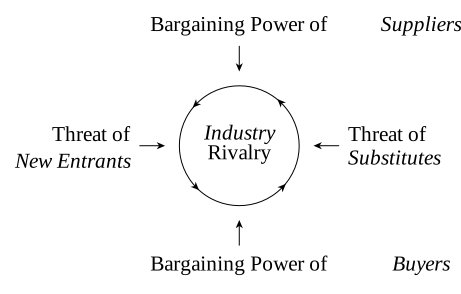
At its core, competitive analysis involves dissecting the forces that shape an industry and a company's position within it. Frameworks like Porter's Five Forces examine the threat of new entrants, the bargaining power of buyers and suppliers, the threat of substitute products or services, and the intensity of rivalry among existing competitors. SWOT analysis complements this by evaluating a firm's internal Strengths and Weaknesses against external Opportunities and Threats. Other techniques include value chain analysis to identify sources of competitive advantage, competitor profiling to understand rivals' strategies and capabilities, and scenario planning to anticipate future market shifts. The process typically involves data gathering, synthesis, and the formulation of strategic recommendations.
📊 Key Facts & Numbers
AI and machine learning are enabling real-time monitoring of market trends, social media sentiment, and competitor activities, moving beyond static annual reports. Platforms like Crunchbase and PitchBook provide vast datasets for startup and competitor analysis. The focus is shifting from understanding existing forces to predicting future disruptions and identifying emerging competitive advantages. Companies are increasingly leveraging predictive analytics to forecast market shifts and competitor actions, moving towards a more agile and adaptive strategic posture. The rise of big data analytics allows for granular insights into consumer behavior and market segmentation, far beyond what was possible even a decade ago.
👥 Key People & Organizations
While Michael Porter is arguably the most influential figure, numerous academics and practitioners have shaped the field. Henry Mintzberg offered critical perspectives on strategy formulation, emphasizing emergent strategies alongside deliberate ones. Joan Magretta has been instrumental in translating complex strategic concepts for broader business audiences. Key organizations like Harvard Business School continue to be centers for research and education in strategic management. Consulting firms such as McKinsey & Company, BCG, and Bain & Company are major disseminators and practitioners of these analytical techniques. Dedicated competitive intelligence associations like the Strategic and Competitive Intelligence Professionals (SCIP) also play a crucial role in professional development and knowledge sharing.
🌍 Cultural Impact & Influence
Management and competitive analysis has profoundly shaped corporate culture and strategic thinking globally. It moved businesses from reactive survival to proactive market positioning. The widespread adoption of frameworks like Porter's Five Forces and SWOT analysis has standardized strategic discussions across industries and continents. This analytical rigor influences everything from product development cycles at companies like Apple Inc. to market entry strategies for startups. The emphasis on understanding customer needs and competitor moves has fostered a more dynamic and customer-centric business environment. It has also elevated the role of strategic planners and market analysts within organizations, making them key advisors to C-suite executives.
⚡ Current State & Latest Developments
The current landscape of management and competitive analysis is being rapidly reshaped by digital transformation. AI and machine learning are enabling real-time monitoring of market trends, social media sentiment, and competitor activities, moving beyond static annual reports. Platforms like Crunchbase and PitchBook provide vast datasets for startup and competitor analysis. The focus is shifting from understanding existing forces to predicting future disruptions and identifying emerging competitive advantages. Companies are increasingly leveraging predictive analytics to forecast market shifts and competitor actions, moving towards a more agile and adaptive strategic posture. The rise of big data analytics allows for granular insights into consumer behavior and market segmentation, far beyond what was possible even a decade ago.
🤔 Controversies & Debates
One persistent debate centers on the rigidity versus flexibility of analytical frameworks. Critics argue that models like Porter's Five Forces can oversimplify complex industries and may not adequately account for disruptive innovation or the role of ecosystems. The reliance on historical data can also lead to backward-looking strategies, failing to anticipate truly novel threats or opportunities. Another controversy involves the ethical implications of competitive intelligence gathering, particularly concerning data privacy and the potential for industrial espionage. Furthermore, there's ongoing discussion about whether competitive analysis should focus solely on market share and profitability or also incorporate broader stakeholder value and sustainability metrics, a point often debated by proponents of stakeholder theory.
🔮 Future Outlook & Predictions
The future of management and competitive analysis points towards hyper-personalization and predictive intelligence. AI will increasingly automate data collection and analysis, freeing up human analysts for higher-level strategic thinking and interpretation. Expect a greater emphasis on understanding complex business ecosystems and network effects, moving beyond linear competitive models. The integration of ESG factors into competitive analysis will become standard, as sustainability and social impact increasingly influence market attractiveness and regulatory landscapes. Predictive modeling will become more sophisticated, allowing businesses to anticipate competitor moves and market shifts with greater accuracy, potentially leading to more proactive and preemptive strategic actions. The ability to synthesize vast, disparate data streams into actionable insights will be the paramount skill.
💡 Practical Applications
Competitive analysis is not just for Fortune 500 companies; it's a vital tool for businesses of all sizes. Small businesses use it to identify underserved niches, understand local competition, and tailor their marketing efforts. E-commerce platforms like Shopify provide tools for merchants to analyze sales data and competitor pricing. Startups employ it to validate their business models, identify potential investors, and refine their go-to-market strategies. Even non-profits utilize competitive analysis to understand the landscape of funding sources and the effectiveness of other organizations in achieving similar social missions. In essence, any entity seeking to achieve a specific objective in a resource-constrained environment can benefit from understanding its competitive context.
Key Facts
- Category
- technology
- Type
- topic